
Key Takeaways
- Stamp duty in Gurgaon depends on location, whether it is within municipal limits, and who is buying, not one flat rate for everyone.
- In urban Gurgaon, that works out to 7 percent for a male buyer, 5 percent for a female buyer, and 6 percent for joint ownership.
- Registration charges follow a slab structure, capped at Rs 50,000 above Rs 90 lakh, not the Rs 15,000 still quoted elsewhere.
- Stamp duty is calculated on whichever is higher, your agreement value or the applicable circle rate, never the lower of the two.
- The gender gap is a real 2 percentage points, on a Rs 1 crore flat that is a Rs 2 lakh difference worth planning around.
- Gift deeds, leases, mortgages, and Power of Attorney transfers do not follow the standard sale-deed rate, check the specific rule.
- Budget for smaller add-on fees too, e-registration, copying, pasting, and mutation charges, minor alone but they add up.
- Work out your full stamp duty and registration cost before you finalise a deal, since it changes what you can actually afford.
“Disclaimer: The figures and information in this article are meant as a general guide and may vary depending on the property, location and latest government rules. Please check the current rates and charges with the relevant Haryana authorities before registering a property or making any financial decision.”
Buying a home in Gurgaon doesn't end at the price you negotiate. Before that sale deed is legally yours, you're paying two separate government charges on top of it, stamp duty and a registration fee, and getting either one wrong is the kind of mistake that shows up as a rejected registration or an unexpected bill on the day you least want one. Together, these make up the stamp duty and registration charges in Gurgaon that every buyer needs to plan for well before signing.
We've pulled together the current stamp duty and registration charges in Gurgaon for 2026, cross-checked across multiple sources on stamp duty Haryana rules, including a correction to a figure that's still circulating incorrectly on several other sites. If you'd rather understand the government valuation these charges are calculated on first, that's covered in our companion guide to circle rates in Gurgaon, this piece picks up from there and walks through what you actually owe and how to pay it.
What Is Stamp Duty, and Why Does Haryana Charge It?
Stamp duty is a state-level tax on the legal documents used to transfer property ownership. In Haryana, it's collected under the Indian Stamp Act, 1899, as amended by state legislation, alongside the Registration Act, 1908, which governs how the sale deed itself gets recorded. That combination is what shapes stamp duty Haryana rules from the ground up.
Practically, this means two things. First, your ownership isn't legally enforceable until stamp duty is paid and the deed is registered, a handshake and a bank transfer don't make you the legal owner. Second, underpaying is a real risk, not just a paperwork inconvenience, deficient stamp duty in Haryana can attract penalties running up to several times the shortfall under the Indian Stamp Act, and banks routinely check stamp duty compliance before releasing home loan disbursements.
Stamp Duty in Gurgaon: Current Rates by Buyer Category
Haryana structures stamp duty around two variables: where the property sits relative to municipal limits, and who's buying it. These two variables are the backbone of how stamp duty in Gurgaon gets calculated for every single transaction.
| Buyer category | Within municipal limits (urban) | Outside municipal limits (rural) |
|---|---|---|
| Male buyer | 7% | 5% |
| Female buyer | 5% | 3% |
| Joint (male + female) | 6% | 4% |
| Joint (two male) | 7% | 5% |
| Joint (two female) | 5% | 3% |
Most of Gurgaon's residential sectors, including the entire Dwarka Expressway, Golf Course Road, and Sohna Road corridors, fall within municipal limits, so the 7%/5%/6% urban slab is what applies to the overwhelming majority of Gurgaon property buyers. The lower rural rate genuinely only applies outside notified municipal boundaries; don't assume a "New Gurgaon" address automatically qualifies for it.
The gender concession is a genuine, meaningful discount, not a token 0.5%. A woman buying the same flat as a man pays 2 percentage points less, which on a ₹1 crore flat works out to a ₹2 lakh difference, one of the clearest ways stamp duty Haryana rules actively reward how you structure ownership. This is exactly why you'll see so many Gurgaon properties registered solely or jointly in a wife's or mother's name, it's a legitimate, government-sanctioned way to reduce the transaction cost.
Stamp Duty on Specific Transaction Types
Not every property transfer in Haryana gets the standard rate. A few categories carry different stamp duty Haryana treatment:
- Gift deed to a blood relative: 3% stamp duty, regardless of gender or location.
- Power of Attorney for consideration: full stamp duty applies, the same as a direct sale.
- Lease deed exceeding one year: stamp duty calculated on the annual rent, not the property value.
- Mortgage deed: 0.5% of the loan amount, capped at ₹40,000.
Circle Rate vs Agreement Value: What You're Actually Taxed On
This is the rule that trips up more buyers than any other part of the process. Stamp duty in Haryana is calculated on whichever is higher, your actual agreement value or the government's notified circle rate for that locality, never the lower of the two.
If you negotiate a flat down to ₹80 lakh but the applicable circle rate values it at ₹90 lakh, you still pay stamp duty on ₹90 lakh. This matters most in sectors where circle rates were recently revised upward, since the gap between what you agreed to pay and what the government now says the property is worth can be substantial. Always check the current circle rate for your exact sector before you finalize a price, not after.
Registration Charges in Haryana: The Real Slab Structure
Here's where a lot of content online, including some of what you'll find repeated in comment sections and older articles, gets this wrong. Registration charges in Haryana are not a flat fee, and they are not capped at ₹15,000. That figure was accurate before October 2018, when Haryana revised the maximum registration fee upward. The current cap is ₹50,000, and it applies on a slab basis tied to property value, and it's the piece of stamp duty and registration charges in Gurgaon that trips up the most buyers.
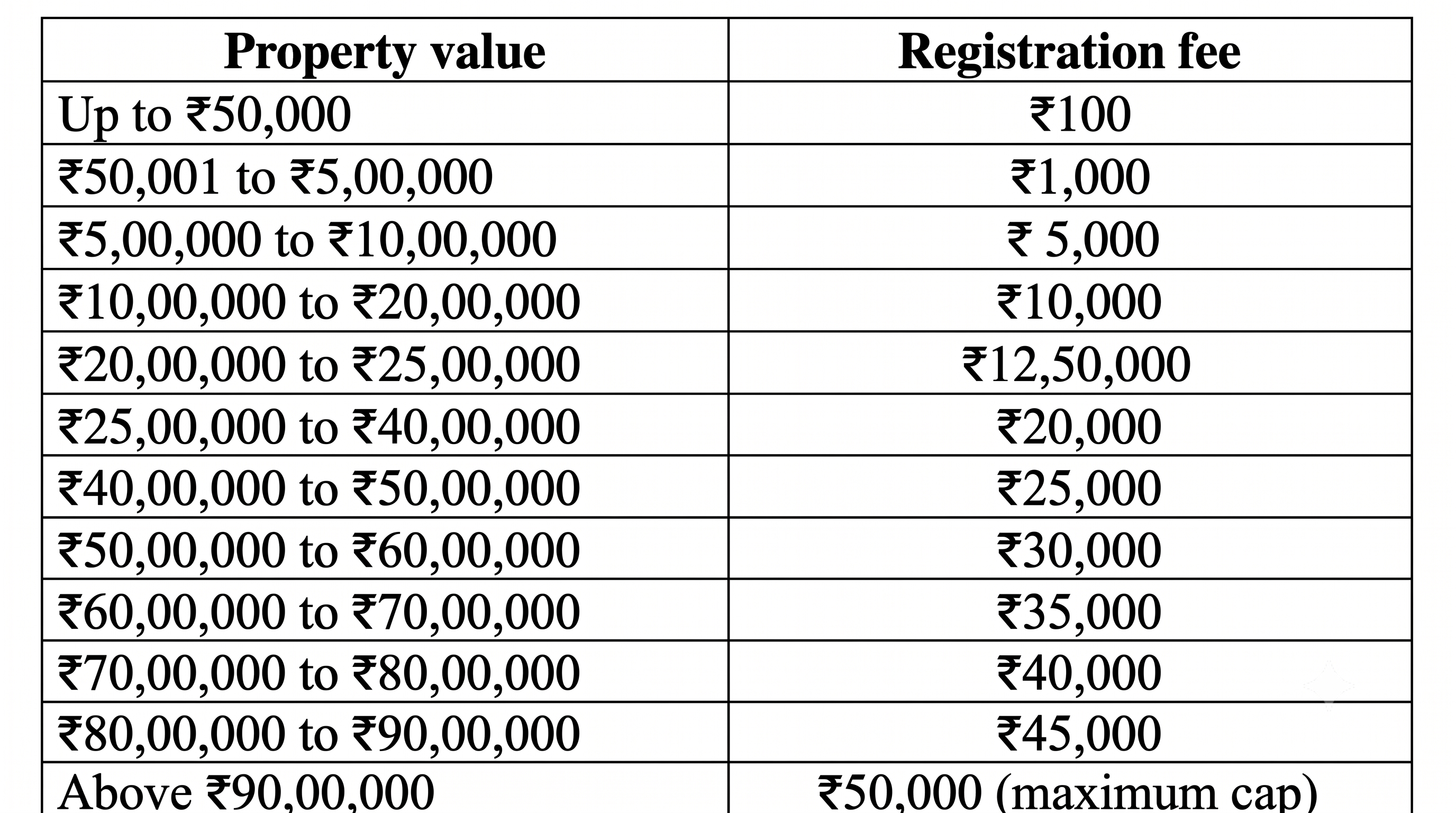
The practical takeaway: whether you're registering a ₹95 lakh flat or a ₹5 crore villa in DLF Phase II, the registration fee tops out at ₹50,000. It doesn't keep scaling with property value the way stamp duty does, which is why registration charges become a proportionally smaller part of your total cost the more expensive the property gets.
Small Additional Fees at the Sub-Registrar's Office
Beyond the slab fee itself, budget for a few smaller charges on registration day, all part of the wider registration charges in Haryana that don't show up in the headline percentage:
- Pasting fee: Around ₹100 per document.
- e-Registration or service fee: Typically ₹100 to ₹300, depending on the deed type and portal used.
- Copying fee: Roughly ₹50-100 for the first page, ₹10-20 for each page after.
- Search fee: ₹100-500, if you request the Sub-Registrar's office to manually check for prior encumbrances.
- Mutation fee: ₹500-1,000, paid after registration to update land records in your name.
None of these are large individually, but budgeting an extra ₹1,000-2,000 beyond the headline stamp duty and registration figures is realistic.
Worked Examples: What You'd Actually Pay in Stamp Duty and Registration Charges in Gurgaon
Example 1: Male buyer, urban Gurgaon, ₹1 crore apartment
| Charge | Amount |
|---|---|
| Stamp duty (7%) | ₹7,00,000 |
| Registration fee (above ₹90 lakh slab) | ₹50,000 |
| Miscellaneous fees | ~₹1,500 |
| Total | ~₹7,51,500 |
Example 2: Female buyer, same ₹1 crore apartment, urban Gurgaon
| Charge | Amount |
|---|---|
| Stamp duty (5%) | ₹5,00,000 |
| Registration fee (above ₹90 lakh slab) | ₹50,000 |
| Miscellaneous fees | ~₹1,500 |
| Total | ~₹5,51,500 |
That's a ₹2 lakh difference from the gender concession alone, on a single ₹1 crore transaction. If you're structuring ownership and this saving matters to you, it's worth discussing with your family and a property lawyer before the sale deed is drafted, not after.
A circle-rate-driven example: say your agreement value is ₹1.2 crore but the circle rate for your sector values the flat at ₹1.1 crore. Since the agreement value is higher here, stamp duty is calculated on ₹1.2 crore, not the circle rate. The "whichever is higher" rule cuts both ways, sometimes it's the circle rate pulling your valuation up, sometimes your own agreement value is already above it.
How to Pay Stamp Duty and Register Property in Gurgaon
The process is now largely digital, run through Haryana's e-GRAS portal for payment and the NGDRS portal for booking your registration appointment.
- Confirm the applicable circle rate for your exact sector or locality before calculating anything else.
- Calculate stamp duty using the higher of your agreement value or the circle rate, applying the correct rate for your buyer category and jurisdiction.
- Generate an e-stamp through the e-GRAS Haryana portal, entering property and buyer details to get a GRN (Government Reference Number).
- Pay online via net banking, debit card, or credit card, and save the e-stamp receipt.
- Book your Sub-Registrar appointment on the NGDRS portal for property registration in Gurgaon.
- Visit the Sub-Registrar's office on your appointed date with all parties and witnesses present, along with original documents.
- Complete biometric verification and photo capture, standard for all parties involved in the transaction.
- Receive your registered deed, typically within one to three working days, issued digitally.
Documents You'll Need
- Executed sale deed
- PAN and Aadhaar for buyer and seller
- Recent passport-sized photographs
- Address proof
- Latest property tax receipt, and an NOC where applicable
- Approved building plan or layout, where relevant
- Payment receipts for the e-stamp and registration fee
What Affects Your Final Stamp Duty and Registration Bill
A handful of variables can move your actual cost meaningfully beyond the headline rate, and together they're what separates a rough estimate from the real registration charges in Haryana you'll owe on registration day:
- Location relative to municipal limits: Urban Gurgaon rates are meaningfully higher than rural Haryana rates, confirm your sector's status before assuming either applies.
- Gender and ownership structure: Single male, single female, or joint ownership all carry different slabs, and the difference is worth planning around, not an afterthought.
- Property type: Residential, commercial, and agricultural land can be treated differently depending on use and local notification.
- Circle rate revisions: A sector that's recently seen its circle rate revised upward changes your minimum taxable value even if your negotiated price hasn't moved.
- Transaction type: Gift deeds to blood relatives, Power of Attorney transfers, and lease deeds all carry their own separate treatment, don't assume standard sale-deed rates apply automatically.
What This Means When You're Budgeting for a Purchase
Run the numbers on a ₹1.5 crore flat and the gender question stops being abstract fast. A male buyer walks into registration owing close to ₹10.75 lakh once stamp duty, the registration slab, and the odd processing fee are stacked up, call it 7-8% on top of the price you actually agreed to. Put the same flat solely or jointly in a woman's name and that figure drops toward ₹8 lakh, a swing of roughly ₹3 lakh that most buyers only discover after they've already picked the flat, not before they've negotiated the price.
That gap is real money against a home loan. It can shift how much you're actually eligible to borrow, and it changes how much room you have left to push back on the base price itself, since a lender looking at your total outlay cares about stamp duty and registration charges in Gurgaon just as much as the sale price on paper. Bring that number into the conversation early, ideally before you've settled on a flat, not once the sale deed is already being drafted and the leverage has quietly disappeared.
Frequently Asked Questions
7% of the higher of the agreement value or the applicable circle rate, for property within Gurgaon's municipal limits. Outside municipal limits, the stamp duty Haryana rate drops to 5%.
It's ₹50,000. The ₹15,000 figure was accurate before an October 2018 revision and still shows up incorrectly on some older articles and forum answers. The current slab structure tops out at ₹50,000 for any property valued above ₹90 lakh.
2 percentage points compared to a male buyer, urban rates go from 7% to 5%, and rural rates from 5% to 3%. On a ₹1 crore property, that's a ₹2 lakh difference.
Whichever is higher. If your agreement value is below the circle rate for that locality, you still pay stamp duty on the circle rate, not your negotiated price.
No. Stamp duty and registration charges are state-level levies and fall outside the scope of GST. This holds true whether you're calculating stamp duty in Gurgaon on a resale flat or a fresh builder booking.
FILED UNDER