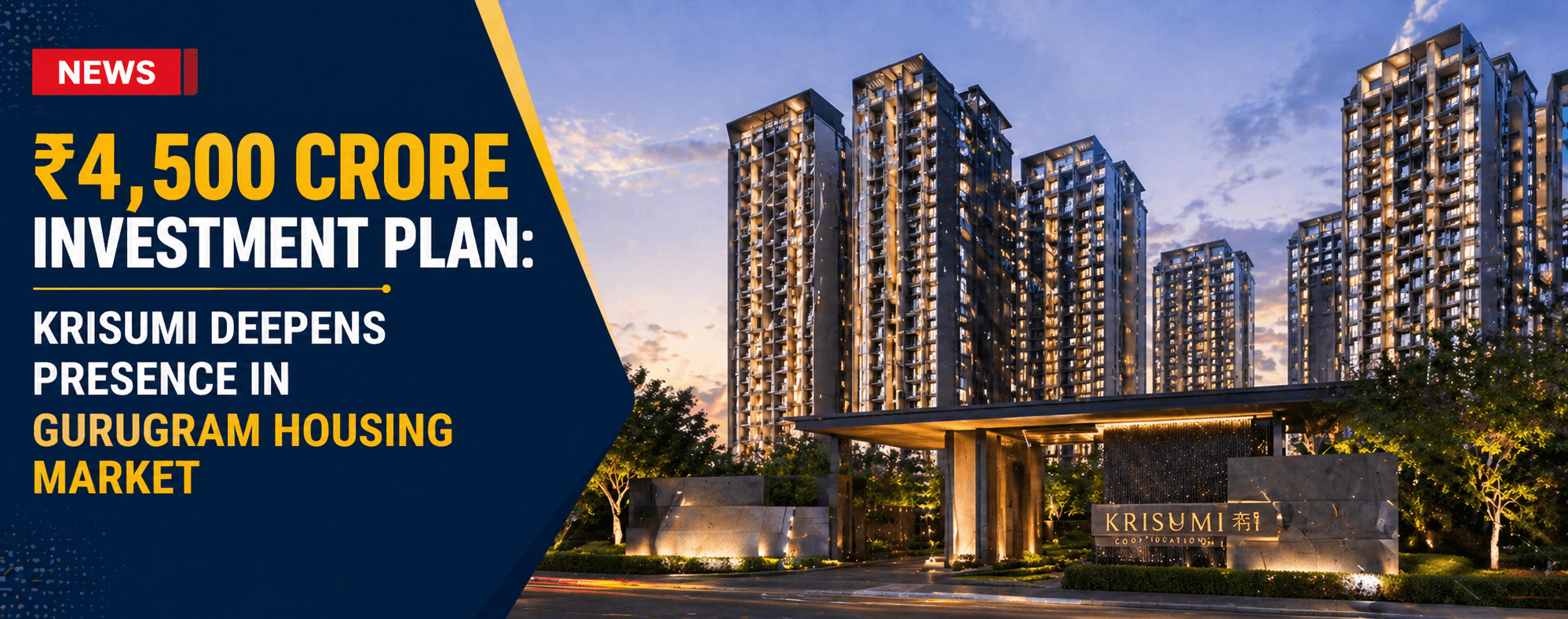
Krisumi Corporation’s decision to invest ₹4,500 crore into its ongoing township in Gurugram is a clear signal of where the company sees long-term value. At a time when real estate developers are being selective with capital deployment, this scale of commitment reflects sustained confidence in the city’s premium housing segment.
The Indo-Japanese joint venture between Sumitomo Corporation and Krishna Group has been developing Krisumi City along the Dwarka Expressway since 2019. With around ₹2,500 crore already invested, the latest announcement marks the next phase of expansion for what is steadily evolving into a large, integrated residential destination.
A Township That Continues to Scale
Rather than approaching the project in isolated phases, Krisumi has taken a long-term township approach. Spread across 33.5 acres, Krisumi City is planned to include 2,772 units once fully completed. The recently launched fifth and sixth phases add another layer to this vision, contributing nearly 1.67 million square feet of development.
These new phases, introduced under the name “The Forest Reserve,” are expected to generate close to ₹4,000 crore in revenue. The product mix reflects a focus on larger homes, with 3 LDK units of about 3,000 square feet, 4 LDK residences around 4,000 square feet, and premium penthouses ranging from 4,500 to 6,000 square feet.
The emphasis on space and layout suggests that developers are responding to a more evolved buyer mindset, where the demand is less about entry price and more about quality of living.
A Clear Trajectory of Price Growth
What makes the project particularly noteworthy is the pricing journey it has seen so far. The first phase was launched at approximately ₹8,500 per square foot. Today, the same development commands close to ₹24,000 per square foot.
This kind of appreciation is not incidental. It reflects both the location advantage of the Dwarka Expressway and the market’s willingness to pay a premium for projects that offer a distinct identity. For early buyers, the project has already delivered strong value, and the expectation is that further infrastructure upgrades in the region could continue to support pricing.
Design Philosophy as a Differentiator
Krisumi’s positioning goes beyond just scale and location. The project draws heavily from Japanese design principles, particularly in the newly launched phases inspired by the idea of “Chinju-no-mori,” which focuses on creating green, tranquil environments within urban settings.
This philosophy translates into a development that prioritises open spaces, thoughtful layouts, and a curated lifestyle experience. The company has consistently highlighted three key pillars guiding its approach: design excellence, disciplined construction processes, and a focus on lifestyle.
In a market where many luxury projects compete on similar parameters, this kind of thematic clarity helps create differentiation.
Early Residents and On-Ground Progress
Another important aspect is that the project is no longer just under construction. Krisumi has already begun handing over units in earlier phases, with around 120 families currently residing within the development. Interestingly, a significant proportion of residents are from Japan, reflecting the cross-border nature of the venture.
This early occupancy gives the project a level of credibility that purely pre-launch developments often lack. It also indicates that the township is gradually transitioning into a lived-in community rather than remaining a future promise.
What This Signals for the Market
The ₹4,500 crore expansion is not just about adding inventory. It underscores a belief that Gurugram’s premium housing market still has room to grow, particularly in well-connected corridors.
For buyers, it means access to more refined products backed by credible developers. For investors, it highlights the importance of looking at projects that combine execution capability with long-term planning.
Krisumi’s latest move fits into this evolving narrative, where real estate growth is increasingly being shaped by scale, design, and sustained investment rather than short-term cycles.
By the numbers · Haryana
38%
Capital-value growth, 2021–2025
50%+
Landscaped open area in new launches
24 mo
Window before supply catches demand