Key Takeaways
- Housing Board Haryana has merged into HSVP, so every new housing scheme application now runs through the HSVP portal, not HBH.
- Haryana housing schemes span EWS, LIG, MIG, and HIG income bands, each with its own eligibility criteria, get your category right.
- To qualify, you need Haryana residency, income proof, no existing property in the state, and no allotment in the last ten years.
- Flat prices and sizes vary by location and scheme, with the most affordable options starting around ₹18 lakh citywide.
- Applications need Aadhaar, address proof, a photograph, and an income certificate for EWS and LIG applicants specifically.
- Allotment has historically run through a computerised draw, followed by verification and a fixed payment deadline after that.
- Budget beyond the flat price too, stamp duty, registration, and development or conversion charges all add to the real cost.
“Important Note: The information in this article is for general guidance only and may vary by scheme, location and the latest HSVP rules or notifications. Please check the official HSVP website and the relevant scheme notice for the latest eligibility, pricing, application dates and other requirements before applying.”
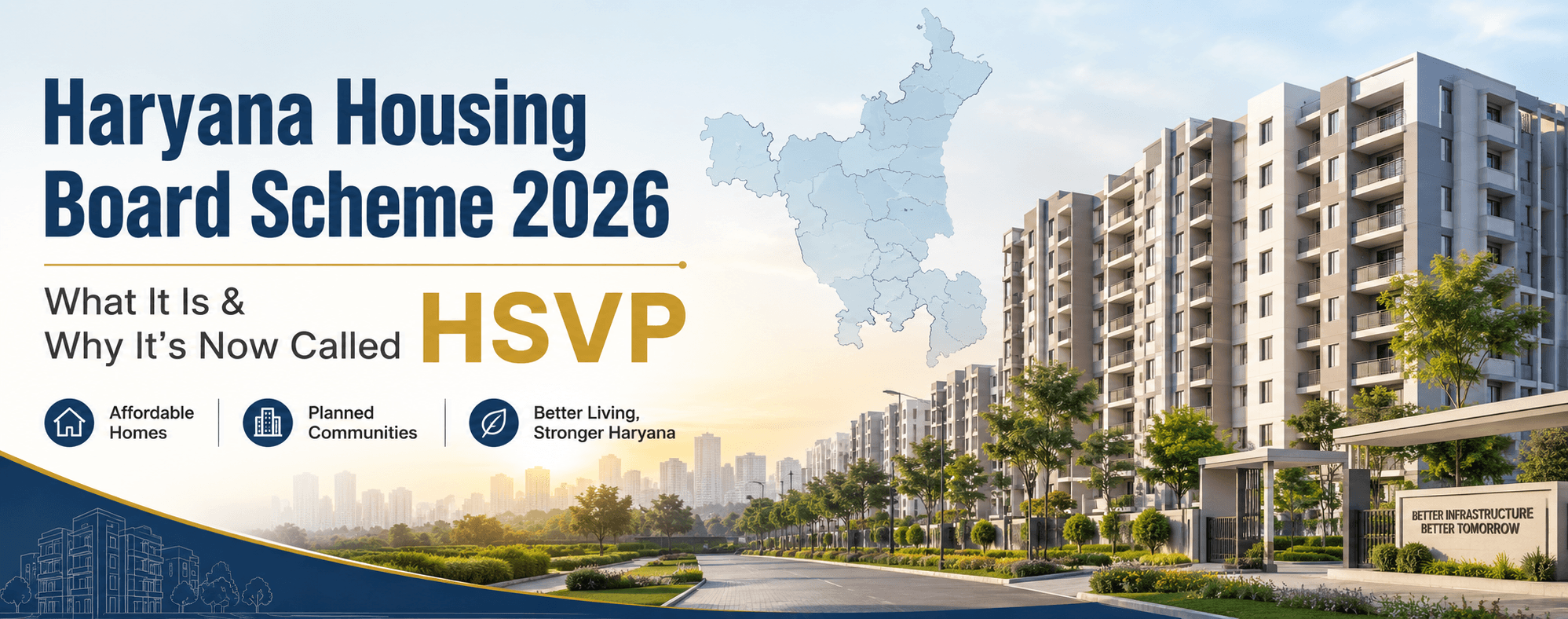
If you've been researching the Haryana Housing Board scheme recently, there's one update that changes almost everything else on this page: Housing Board Haryana doesn't exist as an independent body anymore.
On 20 February 2026, the Haryana Assembly passed a resolution dissolving it and merging its functions fully into HSVP, the Haryana Shehri Vikas Pradhikaran. If you're applying for anything new today, you're applying through HSVP, not the old HBH channels, even though "Haryana Housing Board" is still what most people search for and what we'll keep calling it here, since that's the name this scheme is actually known by.
In this article we will discuss what Haryana housing scheme actually offers, who qualifies, what it costs, and where to apply now that the transition has happened.
What Was the Haryana Housing Board, and What Happened to It?
Housing Board Haryana was established under the Haryana Housing Board Act, 1971, with a straightforward mandate: build and allot houses to residents across income categories, with a particular focus on economically weaker sections. Over 55 years, it ran housing schemes across cities including Panchkula, Gurugram, Faridabad, and several smaller towns, allotting thousands of homes through its own lottery-based draw system.
The Chief Minister's stated reason for the merger was overlapping functions, HBH and HSVP were both running urban housing and development work with increasing duplication, and folding one into the other was framed as an efficiency move rather than a service cut. The opposition pushed back hard on this in the Assembly, arguing it could weaken housing access for lower-income applicants, but the resolution passed regardless. Existing allottees and HBH staff were assured their positions and units aren't affected, this is an administrative consolidation, not a shutdown of the housing itself.
Practically, this means the Haryana Housing Board scheme lives on, the flats, the pricing structure, the income categories, all of it continues, just under new administrative ownership.
Who Qualifies: EWS, LIG, MIG, and HIG Income Categories
Eligibility under the Haryana Housing Board scheme is built around four income bands, and getting your category right matters more than almost anything else in the application, since allotments are made strictly within each slab.
| Category | Annual household income |
|---|---|
| EWS (Economically Weaker Section) | Up to ₹1 lakh |
| LIG (Low Income Group) | ₹1 lakh to ₹2 lakh |
| MIG (Middle Income Group) | ₹2 lakh to ₹4.5 lakh |
| HIG (Higher Income Group) | Above ₹4.5 lakh |
Quick Note: These are Haryana Housing Board's own income bands, not the same as the central PMAY scheme's MIG-I and MIG-II definitions (₹6-12 lakh and ₹12-18 lakh respectively), which cover a completely different program.
At least one other guide to this scheme mixes the two up, quoting PMAY's much higher MIG figures inside its own Haryana Housing Board FAQ, worth double-checking wherever you're reading this, since the two schemes are not interchangeable and applying under the wrong income definition can get your application rejected outright.
Beyond income, the core eligibility rules are:
- You must be 18 or older and a permanent resident of Haryana.
- Neither you, your spouse, nor any dependent children can currently own a residential property anywhere in Haryana.
- You (or your family) must not have received a plot or flat allotment from Housing Board Haryana in the last ten years.
- Valid income proof, issued by a competent authority, is mandatory for EWS and LIG applicants specifically.
Affordable Housing Scheme Haryana: Flat Sizes and Indicative Prices
The scheme spans multiple flat sizes, priced to roughly track the income band they're aimed at:
| Flat size | Approximate price |
|---|---|
| 42.25 sq. m | ~₹18 lakh |
| 52.56 sq. m | ~25 lakh |
| 70.45 sq. m | ~₹35 lakh |
| 90.45 sq. m | ~₹40 lakh |
| 142.71 sq. m | ~₹50 lakh |
These figures are indicative, not fixed, actual pricing depends on location, cost of construction at the specific site, and the particular scheme notification you're applying under. Roughly 580 general-category flats have historically been available across Panchkula, Faridabad, and Gurugram, alongside a much larger allocation, around 7,300 units, reserved specifically for EWS and BPL applicants.
The scheme also covers commercial category flats in select districts, including Sirsa and Bhiwani, alongside the residential allotments that make up the bulk of this affordable housing scheme Haryana runs across the state.
Documents You'll Need to Apply
- Aadhaar card, as identity proof
- Address proof (voter ID, PAN card, or BPL ration card are all accepted)
- A recent passport-sized photograph
- An active, permanent mobile number
- Income certificate, mandatory for EWS and LIG applicants
Keep scanned copies ready in the correct format before you start the online form, mismatched or blurry documents are one of the most common reasons applications get delayed during scrutiny.
How to Apply for the Haryana Housing Board Scheme Now
Since the HSVP merger, this is the process to actually follow:
- Go to hsvphry.org.in, HSVP's official site, not the old hbh.gov.in domain.
- Look under the schemes or property section for current or upcoming Haryana housing scheme announcements.
- Register and fill out the application form online, selecting your correct income category.
- Upload the required documents in the specified format.
- Pay the applicable registration fee online to complete submission.
- Track your application status, draw results, and allotment updates through your account on the same portal.
If you have an existing query tied to an old Housing Board Haryana application, HSVP's grievance or contact section is where that now gets handled, old HBH records have moved across as part of the merger, so there's no separate HBH help desk to fall back on anymore.
How Allotment Works
Allotment under the Haryana Housing Board scheme has historically run through a transparent, computerised draw of lots rather than manual selection, and that structure continues under HSVP:
- The date and time of the draw is communicated to applicants via SMS and email.
- Selected applications go through a further verification check by the authority.
- If an error turns up in your application, you're notified and given a window to correct it before final allotment.
- Successful applicants are typically required to pay a significant portion of the total cost, around 60% has been the historical norm, within a set number of days from the possession letter being issued.
Missing that payment window can mean forfeiting your allotment, so treat the payment deadline as seriously as the application deadline itself.
What Else You'll Pay Beyond the Flat Price
A few additional charges typically apply on top of the base flat price under any Haryana housing scheme:
- Registration fee: a nominal charge at the time of application, historically around ₹500.
- Property registration: once allotted, registering the property is typically calculated as a percentage of the property's value, commonly close to 1%.
- Development and conversion charges: tied to the land's collector rate and local planning norms, these vary meaningfully by location and shouldn't be assumed to be a fixed figure.
- Stamp duty: charged separately at registration, and it varies by gender and by whether the property falls in an urban or rural area, the same rules that apply to any other property registration in Haryana.
What This Means for Your Total Cost
So this is the part that's easy to miss: the development and conversion charges under this scheme aren't set by the Housing Board or HSVP at all. They're pegged to the local collector rate, the same government figure that decides your stamp duty on any property purchase in the state.
Our guide to how circle rates actually get set and revised is worth a read if you want to understand where that figure comes from before you sign anything.
Frequently Asked Questions
Not as an independent body. It was formally dissolved and merged into HSVP on 20 February 2026. The housing schemes themselves continue, but all administration, applications, and services now run through HSVP.
Through hsvphry.org.in. The old hbh.gov.in site has been integrated into HSVP's own portal, and that's now the only official channel for both new applications and queries about older HBH bookings.
₹2 lakh to ₹4.5 lakh annually. This is different from PMAY's MIG-I and MIG-II bands, which go much higher; don't confuse the two schemes when checking your eligibility.
The restriction specifically covers property ownership within Haryana, by you, your spouse, or dependent children. Property owned outside the state isn't automatically disqualifying, but you should confirm this against the specific scheme notification you're applying under, since conditions can vary.
Historically, several months from registration closing to allotment letters being issued, followed by a fixed payment window, often around 100 days, before possession is finalised. Timelines can shift under the new HSVP administrative structure, so treat any historical figure as indicative rather than guaranteed.
FILED UNDER