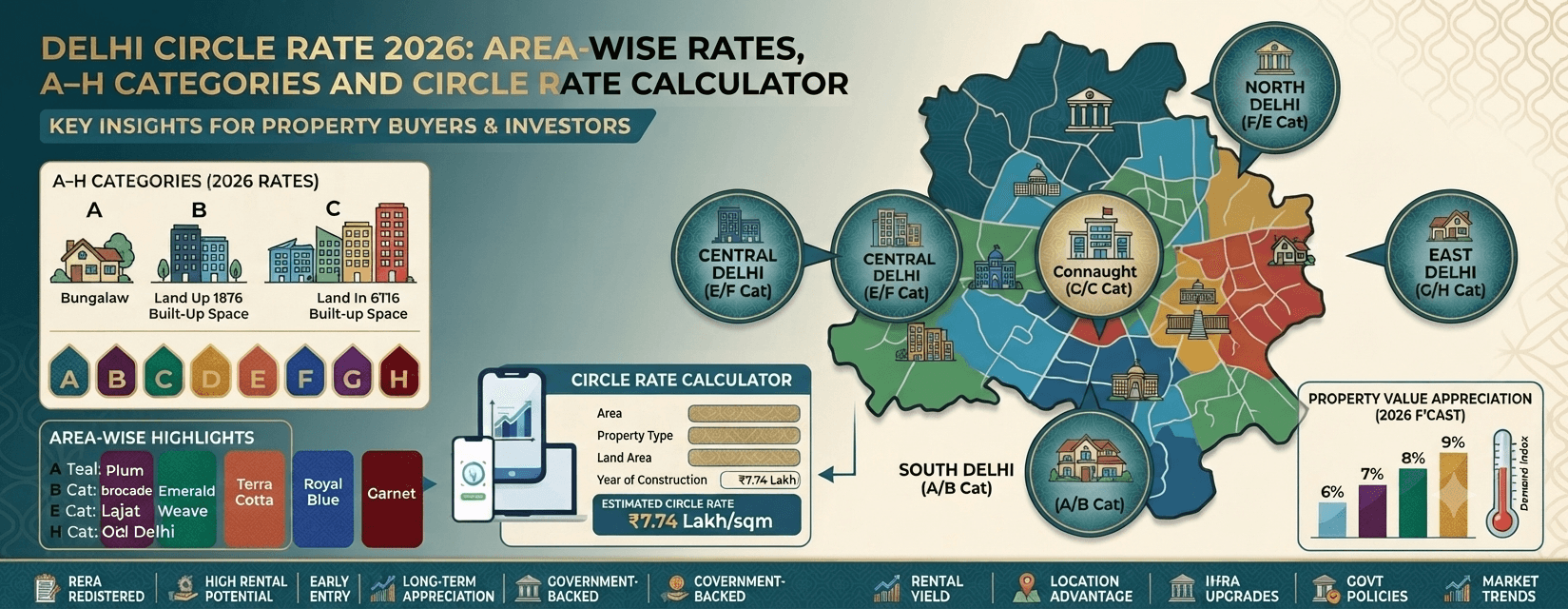
If you're buying, selling, or registering a property in Delhi, the circle rate in Delhi is the one number you really need to understand. It's the government-notified minimum value a property can be registered at, and it decides how much you pay in stamp duty and registration fee. At Hommea, we work with these numbers every day, so we've put the whole picture in one place. This 2026 guide breaks down the Delhi circle rate category-wise (Categories A to H), gives you area-wise and colony-wise rates, walks you through how to calculate circle rate in Delhi with a real worked example, and hands you a ready-to-use circle rate calculator.
We've cross-checked every figure here against the Delhi Revenue Department's notified schedule and the main property portals, so you're working from accurate numbers.
One thing to keep in mind: Delhi's base circle rates have sat on the 2014 schedule for most categories, and a government committee is now reviewing a revision for 2025-26 (more on that below). Before you register, always confirm the live rate with the Sub-Registrar's office.
What Is a Circle Rate?
A circle rate, sometimes called the ready reckoner rate, guidance value, or collector rate, is the lowest price per square metre at which a property can be registered in a given area. The Delhi government sets it through the Revenue Department. The idea is simple: stop people under-reporting what a property is actually worth, which would otherwise rob the exchequer of stamp-duty revenue and feed black money.
Here's the part that catches buyers out. When you register a sale deed, stamp duty and registration are charged on the higher of your actual purchase price or the circle rate value. So if you buy below the circle rate, you still pay duty as though you'd paid the circle rate.
Circle Rate vs. Market Rate: What's the Difference?
| Basis | Circle Rate | Market Rate |
|---|---|---|
| Set by | Delhi Government (Revenue Dept.) | Buyers & sellers / demand-supply |
| Purpose | Minimum value for registration & stamp duty | Actual selling price of the property |
| Typical level | Usually lower than market | Usually higher, especially in prime areas |
| Changes | Revised periodically by notification | Fluctuates continuously with the market |
In most prime Delhi colonies, the market rate sits well above the circle rate. In a few premium pockets, though, that gap has narrowed, and that's a big part of why the government is now looking at a 2026 revision.
Delhi Circle Rate 2026: Category-Wise (A to H)
Delhi sorts its residential localities into eight categories, A at the top (most premium) down to H (least developed and rural). Category A colonies carry the highest circle rate, Category H the lowest. Here's the base residential land rate per square metre for each one.
| Category | Type of Locality | Circle Rate (₹ / sq. m) | Approx. ₹/sq. ft |
|---|---|---|---|
| A | Top-tier premium colonies | ₹7,74,000 | ₹71,900 |
| B | High-value colonies | ₹2,46,000 | ₹22,850 |
| C | Upper-middle localities | ₹1,59,840 | ₹14,850 |
| D | Middle-income colonies | ₹1,28,000 | ₹11,890 |
| E | Lower-middle localities | ₹70,080 | ₹6,510 |
| F | Lower-income colonies | ₹56,640 | ₹5,260 |
| G | Economically weaker / planned | ₹46,200 | ₹4,290 |
| H | Rural / urbanised villages | ₹23,280 | ₹2,160 |
These are indicative base residential rates from the notified schedule. Rates for plots, builder floors, and flats are worked out from them using land plus construction cost and a few multiplying factors.
Circle Rates for Flats & Apartments (by Size)
Flats work a little differently. For multi-storey flats and builder floors, Delhi uses a separate rate slab tied to the flat's built-up area, and private-builder flats sit higher than DDA or cooperative-society flats.
| Built-up Area | Private Builder Flats (₹/sq. m) | DDA / Society Flats (₹/sq. m) |
|---|---|---|
| Multi-storey apartments | ₹1,10,000 | ₹87,840 |
| Above 100 sq. m | ₹95,250 | ₹76,200 |
| 50 – 100 sq. m | ₹79,488 | ₹66,240 |
| 30 – 50 sq. m | ₹62,652 | ₹54,480 |
| Up to 30 sq. m | ₹55,440 | ₹50,400 |
Area-Wise & Colony-Wise Category List (A–H)
Not sure which category your area falls in? Use this quick reference of representative colonies for each one. Delhi has thousands of notified colonies, so check your exact one against the MCD or Revenue Department list before you rely on it.
| Cat. | Representative Colonies / Areas |
|---|---|
| A | Vasant Vihar, Golf Links, Jor Bagh, Sunder Nagar, Anand Niketan, Friends Colony, Defence Colony, Greater Kailash I, Basant Lok, Bhikaji Cama Place |
| B | Greater Kailash II–IV, Hauz Khas, Green Park, Gulmohar Park, Safdarjung Enclave, East of Kailash, Nizamuddin East, Anand Lok, Munirka Vihar |
| C | Chittaranjan Park, Civil Lines, Lajpat Nagar, Malviya Nagar, Janakpuri, Panchsheel, Nehru Enclave, Vasundhara Enclave |
| D | Rajouri Garden, Punjabi Bagh, Paschim Vihar, Anand Vihar, Dwarka, Model Town, Jungpura, Kirti Nagar |
| E | Rohini, Pratap Nagar, Rani Bagh, Chandni Chowk, Geeta Colony, Arjun Nagar, Jamia Nagar (parts) |
| F | Uttam Nagar, Amar Colony, Abul Fazal Enclave, Zakir Nagar, Ganesh Nagar, Daryaganj, Khichripur |
| G | Ambedkar Nagar, Nangloi, Hari Nagar, Dabri, Mangolpuri, Sultanpuri, Vishwas Nagar (parts) |
| H | Aya Nagar, Alipur, Burari, Rithala and other urbanised/rural villages and JJ colonies |
Circle Rate of Land in Delhi (Agricultural)
The circle rate of land in Delhi that's used for farming is set per acre, not per square metre. What you pay depends on the district and whether the village counts as urbanised, rural, or green belt. After recent revisions aimed at stopping farmland being undervalued, the indicative rates look like this:
| District Group | Village Type | Circle Rate (₹ / acre) |
|---|---|---|
| New Delhi, South, South-West | Urbanised | Up to ₹5 crore |
| North, North-West, West | Urbanised / Rural | ~₹3 crore |
| East, Central, North-East, Shahdara | Rural / Green belt | ₹2.25 – ₹2.5 crore |
Commercial plots and construction cost more than residential. The land component sits anywhere between about ₹23,280 and ₹7.74 lakh per sq. m, and commercial construction can add up to ₹25,200 per sq. m, depending on the category.
How to Calculate Circle Rate in Delhi
Want to calculate the circle rate in Delhi for a specific property? It comes down to five steps.
1. Find the locality's category (A to H) and its base circle rate.
2. Work out the property type (plot, builder floor, multi-storey flat, or agricultural land) and pick the matching rate slab.
3. Measure the built-up or plot area accurately, in square metres.
4. Apply the age multiplier if it's a constructed property. Older buildings depreciate the construction-cost part of the value.
5. Multiply area × applicable rate to get the minimum value your stamp duty is charged on.
The Formula
Property Value = Built-up Area (sq. m) × Circle Rate (₹/sq. m) × Age Factor
Age Multiplier (for Constructed Property)
| Age / Year of Construction | Multiplying Factor |
|---|---|
| 2000 onwards | 1.0 |
| 1990 – 2000 | 0.9 |
| 1980 – 1989 | 0.8 |
| 1970 – 1979 | 0.7 |
| 1960 – 1969 | 0.6 |
| Before 1960 | 0.5 |
Worked Example
Say you're buying a 150 sq. m flat in a Category C colony (built-up area above 100 sq. m, private builder). The flat rate that applies is ₹95,250/sq. m.
• Minimum value = 150 × ₹95,250 = ₹1,42,87,500
• Stamp duty (male buyer @ 6%) = ₹8,57,250
• Registration fee (1%) = ₹1,42,875
And if you're actually paying more than ₹1.43 crore, duty is charged on that higher figure instead.
Delhi Circle Rate Calculator
To save you the maths, we've built a free Delhi Circle Rate Calculator you can embed on your page. Pick the category, enter the area and construction year, choose the buyer type (male, female, or joint), and it shows you the minimum registration value, stamp duty, and registration fee right away. How to use it:
• Pick your locality category (A to H), or type in a custom rate.
• Enter the built-up or plot area in square metres.
• Choose the year of construction so it applies the right age factor.
• Set the buyer type to pull the correct stamp-duty slab.
Stamp Duty & Registration Charges in Delhi (2026)
In Delhi, stamp duty depends on who's buying. Women pay a lower rate, a concession meant to encourage more property ownership in their name.
| Buyer / Ownership | Stamp Duty | Registration Fee |
|---|---|---|
| Male | 6% | 1% |
| Female | 4% | 1% |
| Joint (Male + Female) | 5% | 1% |
Inside the NDMC area, stamp duty is 5.5% for men and 3.5% for women; in Delhi Cantonment it's 3%. You also pay a registration fee of 1% of the consideration value, plus a small pasting charge.
What Affects Circle Rates in Delhi
• Locality category and location: A-category prime colonies command the highest rates.
• How the property is used: commercial rates run above residential, and industrial and agricultural land sit differently again.
• Type of construction: multi-storey flats, builder floors, and plots each have their own slab.
• Age of the building: older construction attracts a lower multiplier.
• Infrastructure and amenities: metro links, good roads, and civic facilities push rates up.
• Market trends: revisions try to keep circle rates in step with what the market is actually doing.
Is There a Circle Rate Hike in 2026?
Delhi's circle rates have mostly stayed on the 2014 notified schedule, even as market prices climbed sharply. In 2025, the Delhi government set up a committee of District Magistrates to review the rates and recommend a fresh revision. The proposals on the table reportedly include:
• An across-the-board increase of up to about 35% in several categories.
• New premium sub-categories for ultra-high-value colonies, where market rates have pulled far ahead of circle rates.
• Reclassifying urbanised villages that are currently taxed at agricultural rates into residential categories.
Worth stressing: for now, any hike is still a proposal waiting on official notification. Until the Revenue Department notifies new rates, the existing schedule stands. Always confirm the current rate at the Sub-Registrar's office or the official Delhi Online Registration portal before you register.
Tips for Buyers & Sellers
• Budget for the higher value. Duty is charged on the higher of the circle rate or your purchase price, so plan for that from the start.
• Use the woman-buyer concession. Registering in a woman's name, or jointly, can cut your stamp duty by up to 2%.
• Keep an eye on the 2026 revision. If you're close to buying, wrapping up registration before a hike is notified could save you money.
• Double-check the colony category. A colony near a boundary can sit in a different category than you'd assume, so confirm it on the official list.
Final Word
Once you know the Delhi circle rate for 2026 that applies to you, your colony's category, the right rate slab, and the stamp-duty percentage, you're in control of one of the biggest costs in any property deal. Use the tables and the calculator above to estimate your registration value, keep half an eye on the pending 2026 revision, and always check the live figure with the Sub-Registrar before you sign. At Hommea, that's exactly the kind of legwork we like to take off your plate.
Frequently Asked Questions
It runs between roughly ₹23,280/sq. m in Category H (rural and urbanised villages) and ₹7,74,000/sq. m in Category A (top premium colonies). Flats are rated separately by built-up area, roughly ₹50,400 up to ₹1,10,000/sq. m.
To work out the circle rate of property in Delhi, multiply the built-up or plot area (in sq. m) by the category's circle rate, then apply the age multiplier if it's a constructed property. Stamp duty is charged on that value or your actual price, whichever is higher.
Delhi groups its colonies into eight categories, A (most premium) down to H (least developed and rural). Category A carries the highest circle rate, and Category H the lowest. This is what people mean by the Delhi circle rate category-wise.
No. The circle rate is the government's minimum registration value. The market rate is the actual selling price, and it's usually higher, especially in prime localities.
It's 6% for men, 4% for women, and 5% for joint (male and female) ownership, plus a 1% registration fee. NDMC and Cantonment areas have slightly different rates.
A revision of up to about 35% has been proposed and is under review by a government committee, but no hike takes effect until it's officially notified. Check the current rate before you register.
Disclaimer: The rates in this article are indicative and compiled from the Delhi Revenue Department's notified schedule and public property sources. Circle rates can change by government notification. Confirm current rates and charges with the official Delhi Online Registration System or the Sub-Registrar's office before any transaction. This is for information only and isn't legal or financial advice.
FILED UNDER