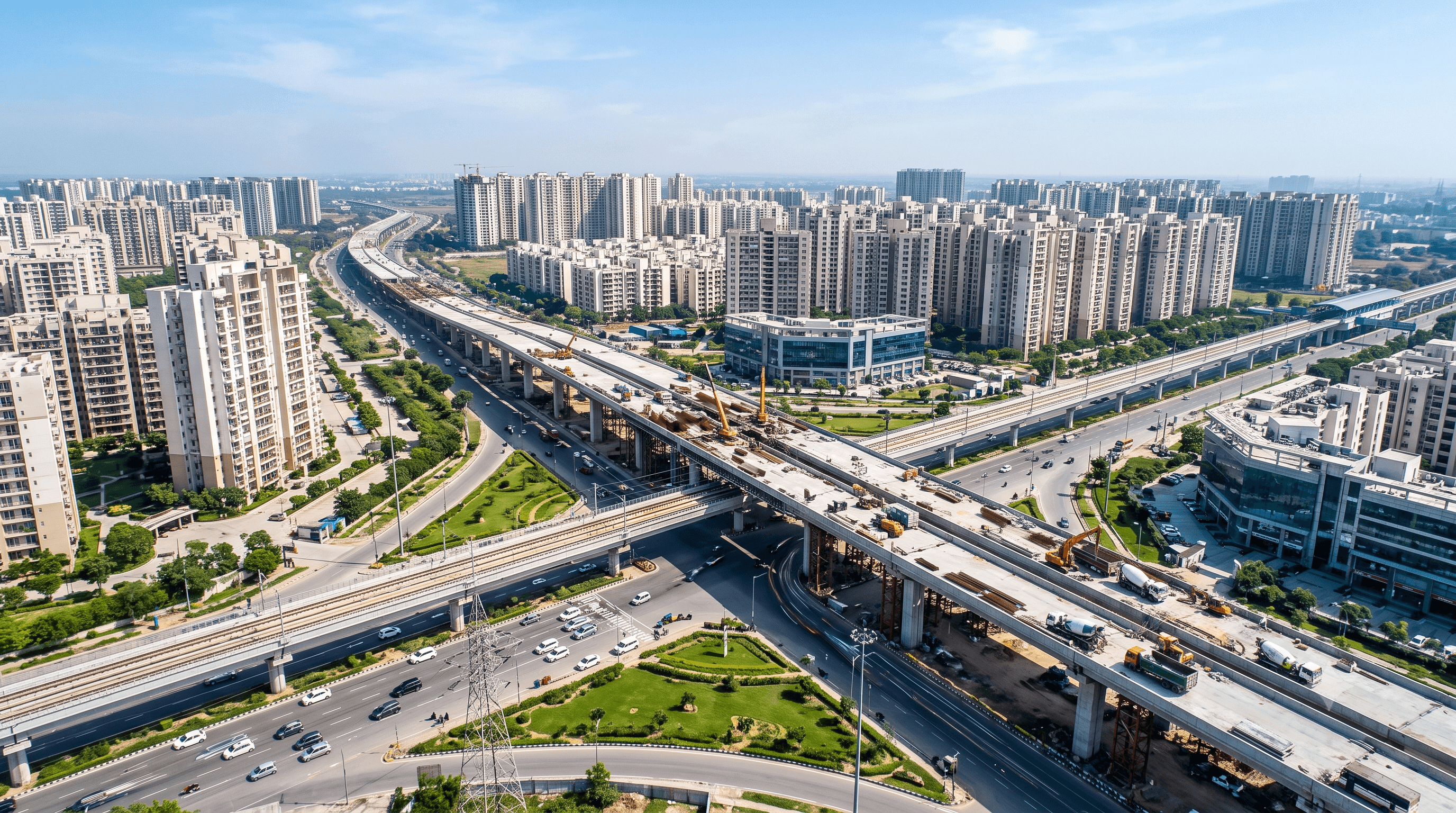
Private equity flows into Indian real estate softened in the first half of this year, but the National Capital Region held its position as the country's leading destination for institutional capital, according to Knight Frank India's half-yearly tracking of the sector, published in late June.
Total private equity investment across Indian real estate fell 23% year-on-year to $1.13 billion in the first six months of 2026, down from $1.47 billion in the same period last year. Knight Frank attributed the decline chiefly to more selective global capital conditions rather than any weakening in domestic demand fundamentals.
Within that reduced pool, NCR accounted for more than a third of total investment, the largest share among the eight cities tracked in the report. The region's performance rested on a mix of office and residential transactions, alongside continued infrastructure expansion and what the report described as a deep pipeline of institutional-grade assets. Office space remained the dominant asset class nationally, drawing 89% of all private equity capital deployed in the half, with residential accounting for the remainder.
Bengaluru, by comparison, drew $115.9 million in the same period, a figure Knight Frank tied to sustained expansion by Global Capability Centres and the city's continued dominance as India's leading technology and office market. That places Bengaluru behind Pune, which attracted $355.9 million on the back of selective residential deals and a growing manufacturing and office base, and Chennai, which recorded $154.7 million driven by industrial, logistics and commercial fundamentals. Mumbai drew $84.3 million despite persistently high asset pricing, while Hyderabad recorded a comparatively modest $4.3 million.
The gap between NCR and Bengaluru in this half-year snapshot is a reversal of the pattern seen as recently as 2024, when Bengaluru led all Indian cities in institutional investment with $299 million against a smaller NCR allocation, according to data from consultancy Vestian covering the first quarter of that year. The shift underlines how quickly capital allocation across Indian real estate markets can move between cities as infrastructure timelines, office absorption and residential launch cycles change.
On the residential side specifically, separate market commentary points to Bengaluru's North corridor, encompassing areas such as Hebbal and the stretch toward Kempegowda International Airport, as the city's strongest zone for capital appreciation, driven by ongoing infrastructure works and airport-linked development. South Bengaluru, by contrast, is more commonly recommended for investors prioritising rental stability over growth, given its more established social infrastructure.
Our market experts at Hommea advise investors comparing these 2 markets to distinguish between end-user-driven demand and purely investor-led demand. Markets where price growth tracks genuine income and employment growth, cited as true of Mumbai, Bengaluru and Gurugram specifically, are generally expected to sustain appreciation cycles for longer than markets driven mainly by speculative buying. NCR's current lead in institutional capital reflects, at least in part, the volume and maturity of investment-grade office and residential stock now available along corridors such as Dwarka Expressway and Golf Course Extension Road, categories of asset that Bengaluru's more fragmented development pattern has been slower to produce at comparable scale.
By the numbers · Delhi
38%
Capital-value growth, 2021–2025
50%+
Landscaped open area in new launches
24 mo
Window before supply catches demand