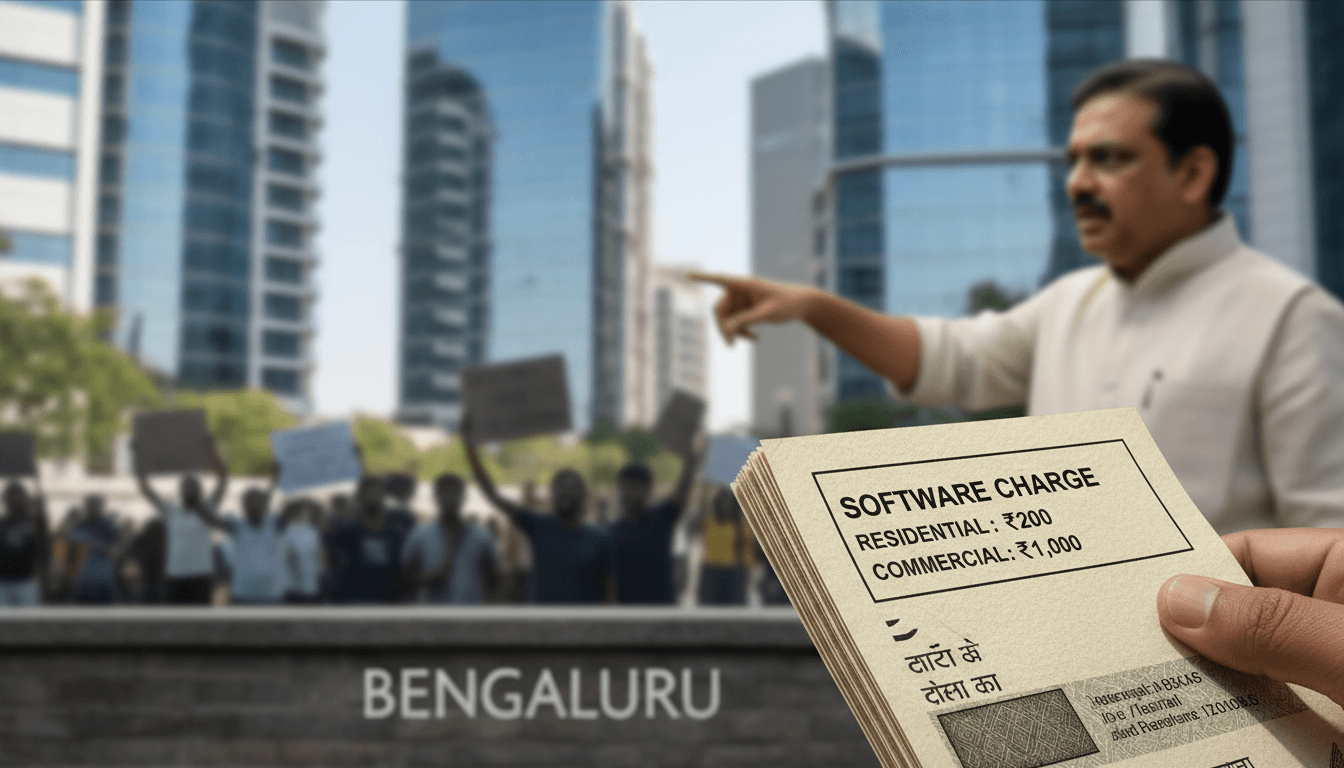
A Small Line Item Causing a Big Argument
A new charge quietly appeared on Bengaluru property tax bills this month, and it hasn't stayed quiet for long. The Greater Bengaluru Authority's five corporations have added an annual "software charge" to property tax bills, ₹200 for residential properties and ₹1,000 for commercial buildings. The amount itself is modest. The controversy around it isn't.
What GBA Says the Charge Actually Covers
According to reporting cited by Hindustan Times, the charge is meant to fund the technology that lets property owners pay their civic dues online, covering the recurring cost of maintaining and upgrading digital infrastructure used for tax collection and other civic services. GBA officials say the authority has no independent revenue source to fund these IT expenses otherwise.
GBA Special Commissioner (Revenue and IT) Munish Moudgil defended the levy directly, telling Hindustan Times, "In building a world-class city, we need world-class software and IT infrastructure." Moudgil pointed to concrete numbers to make the case, nearly 12 lakh e-Khatas issued in under two years, with the average e-Khata application now being processed in seven to eight days at roughly a 98% disposal rate, evidence, GBA argues, that continued investment in these systems is paying off.
Also Read: Embassy Developments to Invest ₹2,000 Crore in 85-Acre North Bengaluru Housing Project
Why the Opposition Isn't Buying It
Karnataka BJP leader B Y Vijayendra went after the charge directly, calling it "another bill pushed onto taxpayers without a clear explanation" and asking GBA to either justify it or withdraw it. "Is this not looting in broad daylight," he said, framing it as part of a pattern, "For Congress Karnataka unit and Chief Minister D K Shivakumar, every new excuse to generate money seems to end at the same destination: the taxpayer's pocket." That's sharp political rhetoric, but the underlying questions being raised by property owners and civic groups are more specific and harder to wave away, what legal provision actually authorises this specific software charge, how the ₹200 and ₹1,000 figures were calculated, how much revenue GBA expects to raise annually, and whether taxpayers were formally informed before the charge simply appeared on their bills.
This Isn't GBA's First Fee Controversy Either
Worth knowing the broader context here. This follows a separate, still-unresolved dispute over the Solid Waste Management user fee for 2025-26, where the Bengaluru NavaNirmana Party publicly demanded a rollback, citing double-charging, public confusion, and penalties applied unfairly, calling the rollout flawed rather than objecting to the fee's existence outright. Two separate new-charge controversies within the same civic restructuring cycle suggests a pattern worth watching, not just an isolated pricing dispute.
You Might Also Like: Data Centres Are Reshaping Wall Street's $17 Billion Real Estate Bond Market
What This Says About Bengaluru's Civic Transition
None of this is happening in isolation from the city's bigger administrative shift. GBA itself was created through the Greater Bengaluru Governance Act, restructuring what used to be a single civic body (BBMP) into an apex authority overseeing multiple corporations. That kind of institutional restructuring routinely comes with exactly this sort of friction, new bodies need new funding mechanisms, and residents understandably want clarity on what they're actually paying for before a new line item lands on their bill without warning.
What This Means for Property Owners and Buyers in Bengaluru
Small recurring charges like this rarely move property values on their own, but they're a genuinely useful signal of how a city's civic administration is evolving during a major restructuring, and it's worth watching whether GBA formalises a clear legal basis for the charge or walks it back under pressure, the same way it may yet have to revisit the SWM fee rollout. Anyone tracking Bengaluru's broader GCC-driven real estate growth should keep half an eye on this kind of civic-administration friction too, since a functioning, well-funded digital tax system is part of what actually makes a growing city liveable at scale, not just a line item to complain about.
By the numbers · BENGALURU, Karnataka
38%
Capital-value growth, 2021–2025
50%+
Landscaped open area in new launches
24 mo
Window before supply catches demand