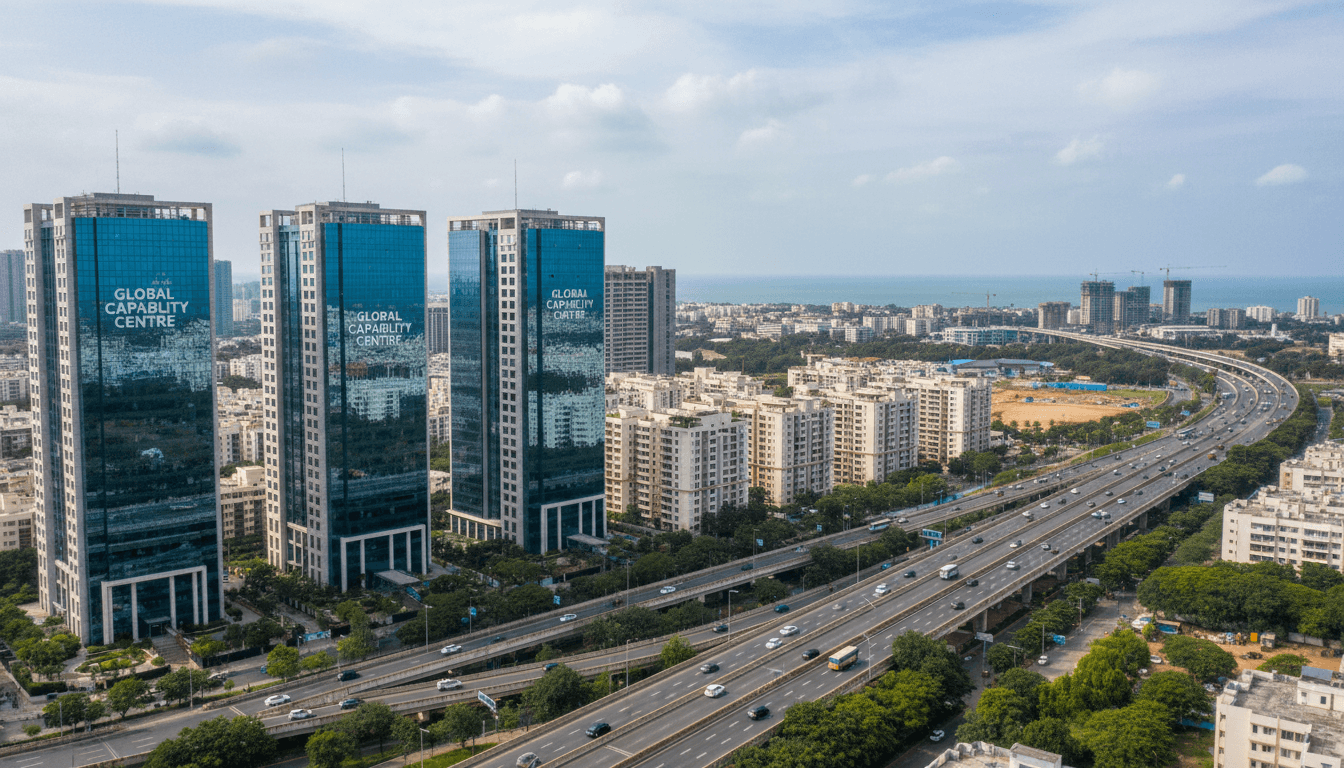
A City Rewriting Its Own Real Estate Map
Chennai has spent the last few years quietly building one of India's strongest Global Capability Centre stories, and the knock-on effect on real estate is now hard to miss. GCCs accounted for a record 55% of Chennai's office leasing in Q1 2026 alone, according to Cushman & Wakefield data, a share that's pulling both Grade A office demand and premium housing along with it.
Why Chennai Specifically Is Pulling Ahead
Part of the answer is pure economics. Chennai's Grade A office rentals run roughly 19% lower than Bengaluru's, and sit well below Mumbai, Delhi and Gurugram too, according to CRE Matrix's recent report on the city. That gives occupiers access to institutional-quality space at meaningfully lower occupancy cost, exactly the kind of arbitrage GCCs have been chasing as they scale across India. Leasing volumes in the city have expanded more than fivefold since 2021, the sharpest growth rate of any major Indian city over that stretch.
Also Read: Real Estate Leads Radio Advertising With 17% Share as Category Grows 20%
The Infrastructure Bet Behind the Boom
Few Indian cities are investing as aggressively in connectivity right now. Chennai currently runs a 54-km metro network, with another 119 km under construction, the second-largest under-construction metro portfolio among Tier-1 cities, backed by more than ₹63,000 crore committed to Metro Phase II alone. Add the Chennai-Bengaluru Expressway, a proposed high-speed rail corridor linking the two cities, and ongoing airport expansion, and the city is building the connectivity layer this office and housing growth needs to actually hold up over time, not just for the current cycle.
Where the Growth Is Actually Concentrating
Southern Suburbs I, II and III together already account for more than 81 million sq. ft. of office stock, and are expected to absorb a significant share of the roughly 42 million sq. ft. of planned future supply. On the residential side, the pattern is unmistakable, premium and luxury housing specifically saw a 253% quarter-on-quarter surge in new launches in Q1 2026, as developers responded directly to the high-income tenant and buyer pool GCC expansion is creating. That's the same causal chain we've tracked repeatedly in NCR this year, sustained office absorption translating into residential demand nearby, just playing out in a different city.
Worth Reading: HRERA Orders Chintels India to Reinstate a Cancelled Plot, Pay 10.8% Delay Interest
A Pattern Worth Comparing to Gurugram's Own Story
This is genuinely worth setting alongside what's already been tracked around Gurugram crossing 100 million sq. ft. of office stock earlier this year, largely on the back of the same GCC-driven demand. Chennai and Gurugram are, in a real sense, running the same playbook in parallel, infrastructure investment paving the way for office absorption, which in turn pulls premium residential demand into the surrounding corridors.
Where they differ is cost, Chennai is positioning itself as the lower-cost alternative within that same national GCC growth story, which could make it a genuine long-term competitor to the more established hubs rather than just a secondary market.
What This Means for Investors Weighing Cities Beyond NCR
For anyone tracking where India's GCC-driven real estate growth is heading next, this is a useful reminder that the fundamentals reshaping Gurugram and Noida aren't unique to NCR, the same office-to-housing chain is playing out in Chennai's southern corridors right now, at a meaningfully lower entry cost. Worth keeping an eye on how this trend develops nationally even while NCR remains the primary focus, since capital increasingly moves toward whichever city offers the strongest infrastructure-to-cost ratio at a given point in the cycle.
By the numbers · CHENNAI, Tamil Nadu
38%
Capital-value growth, 2021–2025
50%+
Landscaped open area in new launches
24 mo
Window before supply catches demand