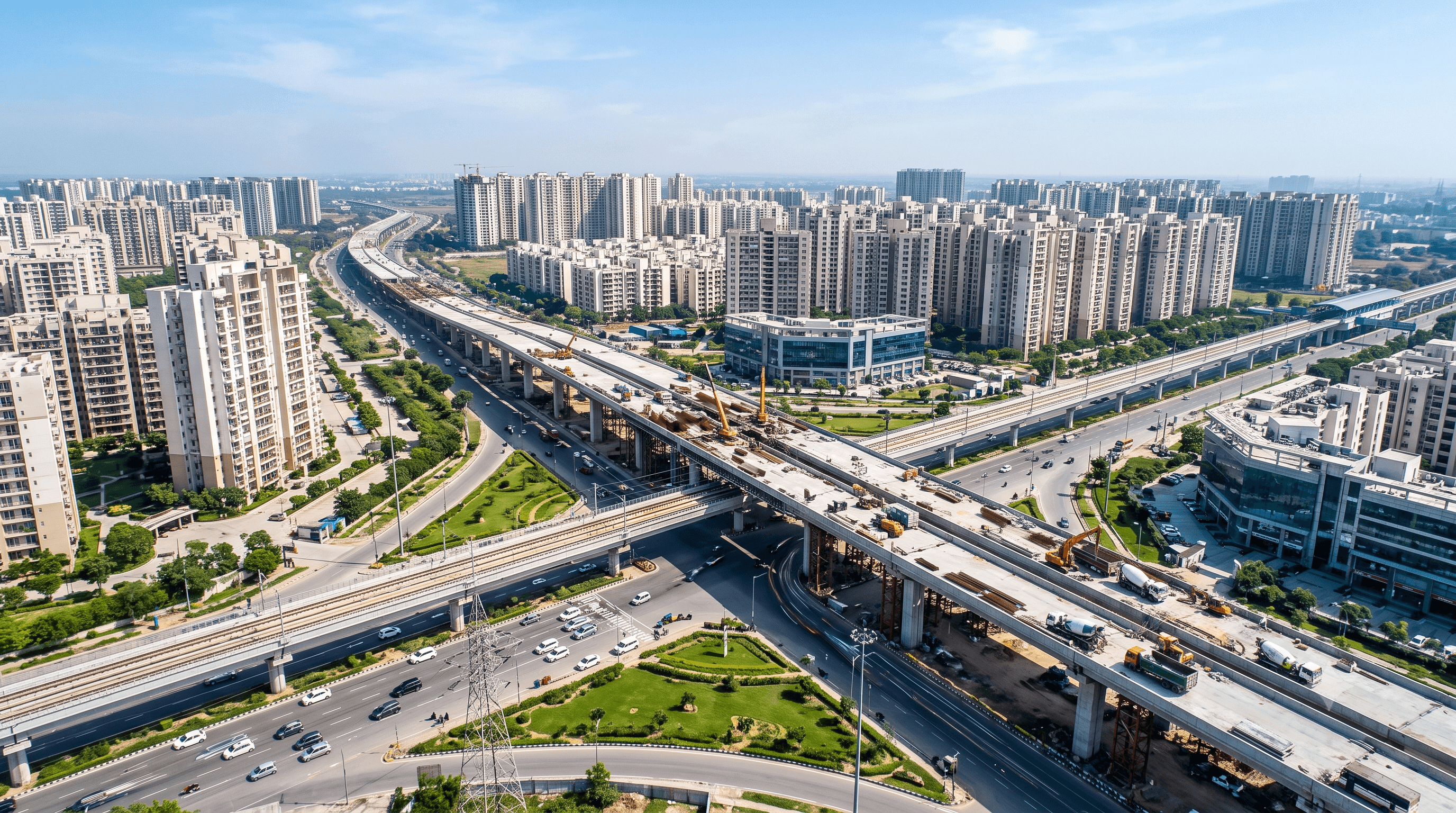
Dwarka Expressway has completed its transition from a decade-long construction project to a fully functional eight-lane corridor connecting Delhi's Dwarka to Kherki Daula on NH-48, complete with the country's first eight-lane shallow tunnel. Yet property rates along its length remain far from uniform, with a gap of roughly 15 to 20% separating its cheapest and most expensive residential sectors.
The corridor's twenty-nine kilometre stretch runs through a string of sectors, principally 99, 102, 103, 104, 106, 108, 109, 110, 111, 112 and 113, each shaped by a different mix of land parcel timing, developer profile and distance from either the Delhi border or the NH-48 junction. Sectors 113 and 114, closest to the Delhi border, currently command the corridor's premium pricing and have reported inventory absorption of 40 to 60% within initial launch phases, according to industry tracking. Sectors 103 and 104, sitting roughly mid-corridor, have moved close to parity with Golf Course Extension Road pricing while offering shorter airport access.
By contrast, Sectors 102 and 106, along with the broader 99-103 band, continue to trade at a 15 to 20% discount to these comparable micro-markets. Real estate advisories tracking the corridor attribute the gap chiefly to positioning rather than construction quality: these sectors sit further from both the Delhi border and the metro alignment now under construction, and several were developed by a wider mix of Tier 1 and smaller regional builders, which has kept average entry prices lower even as underlying infrastructure has caught up.
The Delhi Metro's Blue Line extension, running from Dwarka Sector 21 to Kherki Daula, has a confirmed 2026-27 completion window. Once operational, Sectors 102, 103, 104 and 109 are widely expected to see a further 15 to 20% appreciation, based on the pattern metro connectivity has produced in other NCR corridors historically. Until that line opens, no part of Dwarka Expressway is metro-served today, a fact that buyers weighing the current price gap should keep in mind before assuming it will close quickly.
Rental yields across the corridor currently sit in a fairly narrow band. Premium projects in Sectors 103 and 104 return an estimated 3 to 4% gross yield, while the more affordable 102-106 stretch offers a slightly higher 4 to 5%, reflecting the lower entry price relative to achievable rent. Commercial assets along the corridor, where operational, have reported yields closer to 6 to 7%, considerably ahead of residential returns.
More than 25,000 residential units are currently under various stages of construction along the corridor, according to market estimates, with the bulk concentrated in the mid-segment Rs 1.5 to 3 crore band, where analysts flag a risk of resale margin compression given the volume of supply entering the market simultaneously. The luxury segment, priced above Rs 5 crore, has comparatively limited inventory against sustained demand.
Our experts at Hommea advise buyers to independently verify a project's actual distance from the Dwarka Expressway, as some developments marketed under the corridor's name are located two to three kilometres away and offer materially different internal connectivity. They also recommend confirming the project's RERA registration directly on the Haryana RERA portal before booking.
By the numbers · Gurugram
38%
Capital-value growth, 2021–2025
50%+
Landscaped open area in new launches
24 mo
Window before supply catches demand