Dwarka Expressway's Five-Year Number
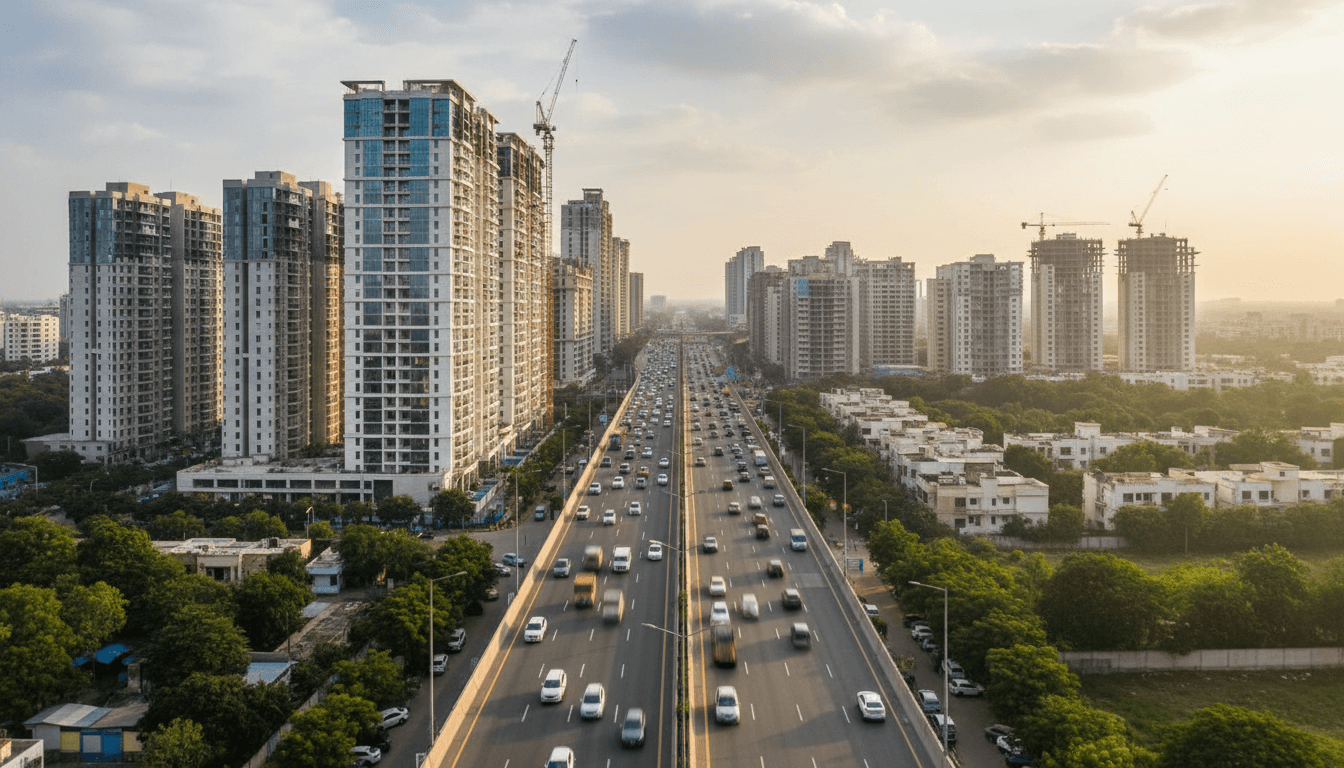
Home prices along the Dwarka Expressway corridor in Gurugram have risen 135% over the past five years. That's according to a report covered by Hindustan Times and its Hindi edition, Live Hindustan. The scale of that jump is what's turning heads. This corridor spent most of the last decade known mainly for its delayed construction timeline. In five years, it has repriced itself into direct competition with Gurugram's established luxury addresses on Golf Course Road.
How This Lines Up Against Other Estimates
The 135% figure sits comfortably inside the range other data sources report for the same stretch. That's reassuring, even though we couldn't access the full underlying report ourselves. 99acres' own price-trend data shows flat rates up 152.3% over the trailing five years.
Business Today's reporting in August put broader corridor appreciation at 95-105% over seven years, accelerating to 110-120% in just the last five. Individual projects have moved even faster. Smartworld One DXP has reportedly seen its resale value nearly double since launch. Krisumi City's per-square-foot rate has climbed from around ₹8,500 to close to ₹24,000 since 2021. Read together, a 135% five-year figure for the corridor looks plausible rather than an outlier.
What's Actually Driving the Repricing
The Dwarka Expressway's shift from paper promise to physical reality is the clearest explanation on offer. Its Haryana and Delhi sections are now fully operational. That includes an 8-lane tunnel section near IGI Airport, which has cut travel time between Gurugram and the airport meaningfully. The cloverleaf junction is complete too, and social infrastructure keeps expanding. The corridor also sits close to upcoming developments like the India International Convention Centre and Diplomatic Enclave II. Together, these give buyers a straightforward reason to keep showing up. Developers including DLF, M3M, Godrej, Sobha and Krisumi have all expanded their presence here in response.
Also Read: Most Expensive City in India: 2026 Rankings, Cost of Living, and Real Estate Data
Old Luxury Is Still Setting the Ceiling, For Now
Even at 135% five-year growth, Dwarka Expressway hasn't overtaken Golf Course Road on absolute price. DLF's Camellias-Aralias-Magnolias trio there still commands resale rates of ₹75,000-80,000 per square foot, well above anything Dwarka Expressway currently fetches. What's changed is the comparison itself. Real estate analysts tracking the corridor say something specific happens when a rare new-build plot comes up on Golf Course Road now. Its pricing gets measured against the resale benchmark set by these older towers, not against other new launches, simply because so little fresh land remains there. Dwarka Expressway still has room to build. That's part of why its price growth has run this hard without hitting a supply ceiling yet.
Circle Rates Are Catching Up Too
Government-notified circle rates have been playing catch-up with this market move. Haryana's proposed 2026-27 collector rates include hikes of up to 67% for Dwarka Expressway sectors specifically. That's on top of increases as high as 77% in the two years before. The intent is deliberate: closing the gap between official valuations and what properties actually sell for.
For buyers, that translates directly into higher stamp duty and registration costs on any purchase here going forward. It's a real cost, and one that's easy to underweight when you're focused only on the headline appreciation number.
What Could Keep This Trajectory Going, or Slow It Down
The next leg of appreciation likely hinges on how much of the corridor's infrastructure story is still ahead of it. The Global City project, a 1,000-acre business district planned along the corridor, remains in its early stages. If it delivers on schedule, it could do for this corridor what Cyber City once did for Golf Course Road's valuations. Metro connectivity is the other open variable.
Extension plans exist on paper, but Gurugram's metro expansion has historically moved slower than its road infrastructure. Since this corridor's investment case leans so heavily on connectivity, its next price move will likely track how quickly that gap closes. Supply is the third piece. Dwarka Expressway still has a steady pipeline of new launches, unlike Golf Course Road's near-total lack of available land. That means price growth here will keep depending on demand absorbing new supply, rather than scarcity doing the work on its own.
By the numbers · GURUGRAM, Haryana
38%
Capital-value growth, 2021–2025
50%+
Landscaped open area in new launches
24 mo
Window before supply catches demand