
Key Takeaways
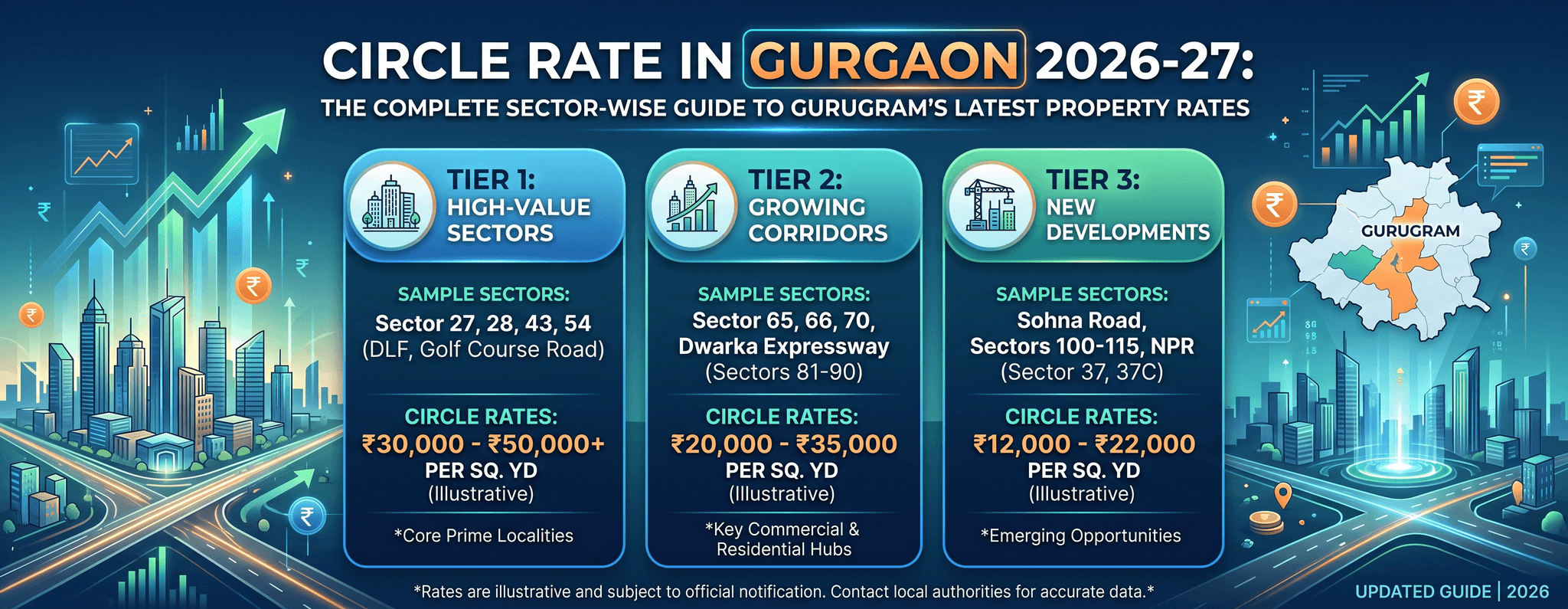
- Circle rates vary by sector, locality, property type, and even specific plot or road, always check the exact rate for your address.
- The 2026-27 revision took effect 1 April 2026, with sharp hikes in several fast-growing pockets, no change at all in others.
- Dwarka Expressway and Southern Peripheral Road saw some of the steepest circle rate increases anywhere in Gurugram this cycle.
- Stamp duty is calculated on whichever is higher, your declared price or the applicable circle rate, never the lower of the two.
- CLU status, highway frontage, corner plots, and property classification can all push the assessable value above the base rate.
- Plots, group housing, independent floors, flats, and commercial property are each rated differently, even in the same sector.
- Always check the current official Collector Rate notification before registering, this guide is a starting point, not the final word.
“A Quick Note: The rates and charges mentioned here are for general information only and may change depending on government updates and the details of your property. Please check the latest figures with the Gurugram district administration or a qualified professional before making a property or financial decision.”
If you're buying, selling, or registering property in Gurugram this year, one number decides more of your final bill than almost anything else: the circle rate. It's not the price you negotiate with a seller. It's the government's own floor price, and Haryana just revised it, sharply, in some pockets of the city, and not at all in others.
We've pulled together the current 2026-27 circle rate in Gurgaon, sector by sector, the stamp duty math it feeds into, and the specific corridors, where the numbers have moved the most. Think of this as a working reference for Gurgaon property circle rates, not a one-time headline, we've also flagged everywhere our own sources disagreed with each other, rather than picking one figure and hoping it holds up.
What Are the Circle Rates in Gurgaon?
Circle rate, officially called the collector rate in Haryana, is the minimum value the government assigns to land or property in a given area, for the specific purpose of calculating stamp duty and registration charges when you register a sale deed. You'll also see it called the guidance value or the ready reckoner rate in other states, in Gurugram specifically, "collector rate" and "circle rate" are used interchangeably, and you'll see both terms on the district's own paperwork.
The Gurugram circle rate isn't one number for the whole city. It's set locality by locality, sector by sector, and even road by road in some cases, which is why a flat in Sector 15 and a flat in Sector 108 can carry very different government-notified values even at similar market prices.
Circle Rate vs Market Rate in Gurgaon: The Rule That Actually Matters
Here's the part that trips people up. Circle rate and market rate are two separate numbers, and only one of them decides what you pay in stamp duty.
- Market rate is whatever a buyer and seller actually agree to pay, driven by demand, location, amenities, and negotiation.
- Circle rate is the government's fixed floor, revised periodically based on prior registry data and prevailing market trends.
When you register a property, the sub-registrar's office calculates stamp duty on whichever figure is higher, the declared transaction value or the applicable circle rate, never the lower one. If you try to register a property below its circle rate, the registration can be refused outright. This is precisely why circle rate matters even if you and the seller have already agreed on a lower price, you can't simply write that lower number into the deed and expect it to hold.
In fast-moving corridors like Dwarka Expressway, this cuts both ways. Circle rates there have historically lagged market prices, so buyers paid stamp duty on the lower, older government figure even as actual transaction prices ran well ahead. The 2026-27 revision is Haryana's attempt to close that gap, which is exactly why the hikes in these newer sectors are so much sharper than in the city's older, already-mature sectors.
Gurugram Circle Rate 2026-27: What Changed, and When
The revised collector rates for Gurugram district took effect from 1 April 2026, following a draft notification period where objections and suggestions were accepted until 30 March. The Deputy Commissioner's office confirmed the broad shape of the revision directly:
- Average increase of 15% to 30% across residential, agricultural, and commercial land rates district-wide.
- 51% of the district's area saw no change at all, mostly older, already-mature sectors and licensed colonies.
- Around 11% of areas saw increases as steep as 75%, concentrated in fast-developing zones where rapid infrastructure work has pushed market values well past the old government rate.
The revision draws on three inputs: prior year registry data, prevailing market trends, and infrastructure development in each specific area, which is why the increases are so uneven. A sector that's barely changed in five years gets frozen or nudged slightly, a sector that's seen a metro spur, an expressway, or a wave of new launches gets revised hard.
Gurugram district's rates aren't limited to Gurugram tehsil either. Manesar, Sohna, Farrukhnagar, Wazirabad, and Pataudi tehsils each carry their own separate rate notification, so if your property sits in one of these, you're checking a different document from the main Gurugram tehsil PDF.
Gurgaon Property Circle Rates by Area: The Current Numbers
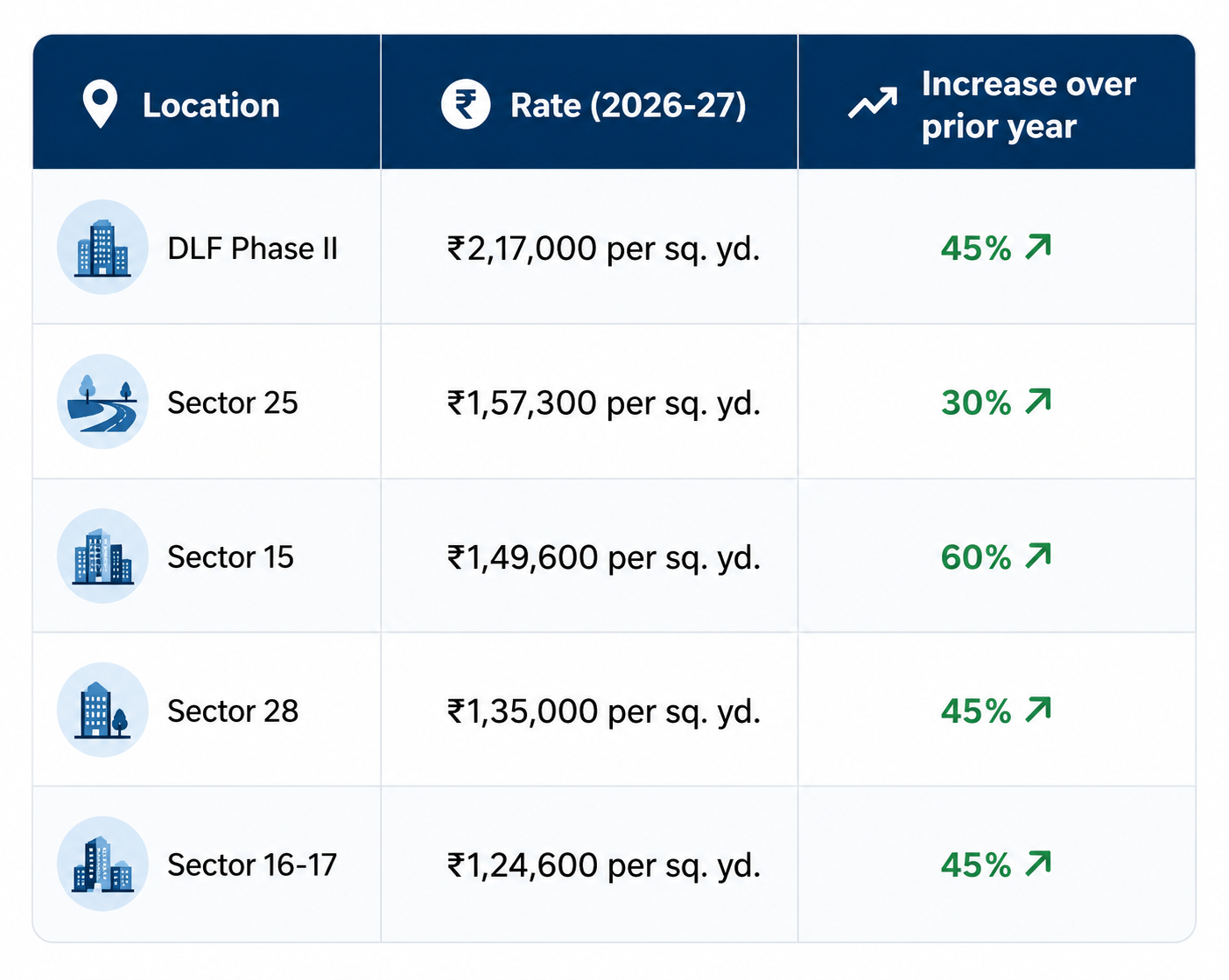
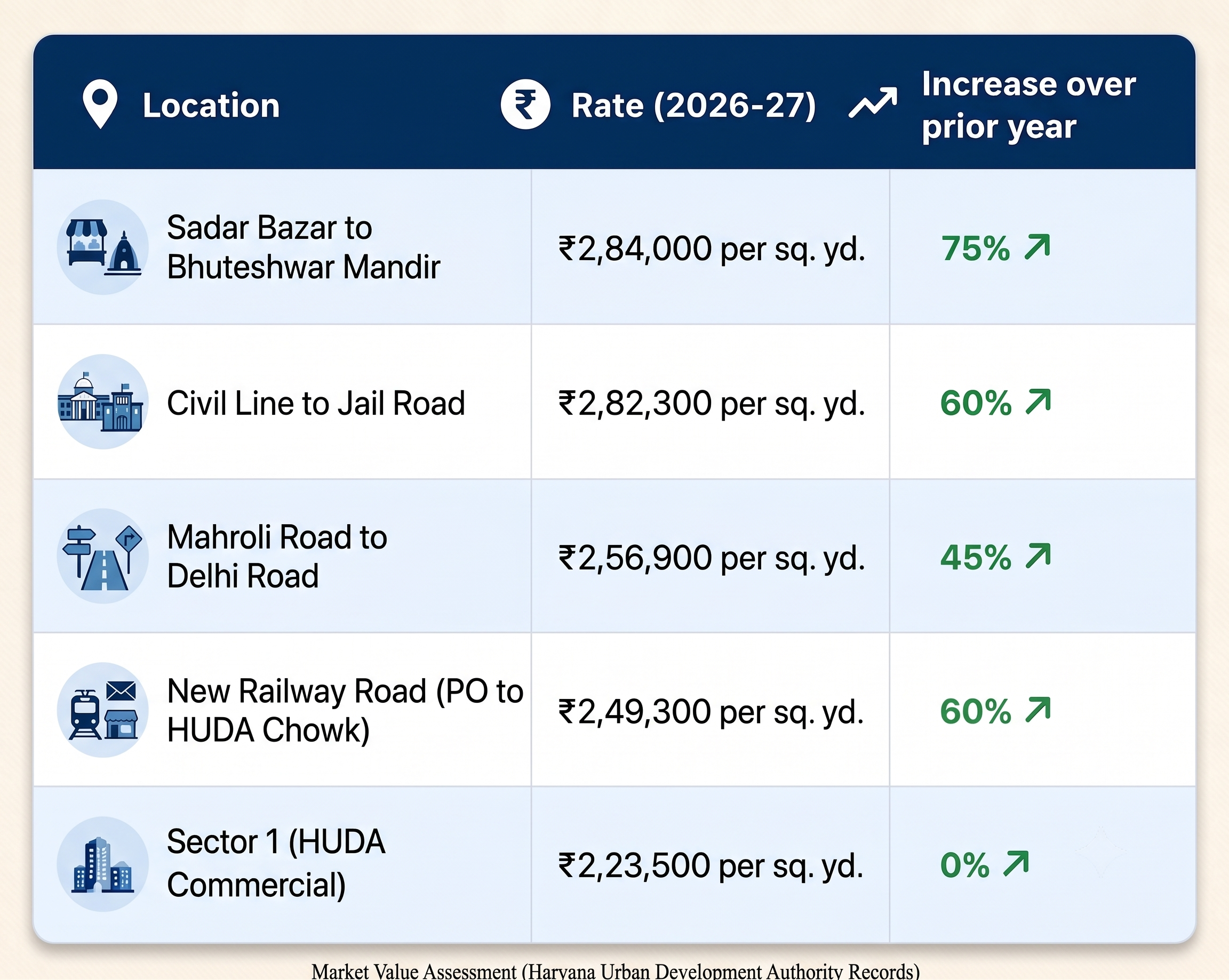
Rates vary enormously by exact location, but here's where Tehsil Gurugram's 2026-27 figures currently stand at the top and bottom of the range, based on the official rate document. If you're comparing Gurgaon property circle rates across sectors, these tables are the fastest way to see where you land.
Highest residential circle rates (Tehsil Gurugram)
Highest commercial circle rates (Tehsil Gurugram)
If you're tracking Sectors 104-115 specifically, here's where you need to slow down, because our sources genuinely don't agree with each other, and we'd rather tell you that plainly than paper over it.
The Tribune's coverage, based on the draft notification released for public objection in March, reported some of the sharpest increases in the entire district for this stretch:
Dwarka Expressway Circle Rate Hike: Sector 104-115 Numbers, Explained
If you're tracking Sectors 104-115 specifically, here's where you need to slow down, because our sources genuinely don't agree with each other, and we'd rather tell you that plainly than paper over it.
The Tribune's coverage, based on the draft notification released for public objection in March, reported some of the sharpest increases in the entire district for this stretch:
- Residential plot rates in Sectors 104-115 rose 62% to 67%, from roughly ₹40,000-44,000 per sq. yd. to ₹66,125-70,000 per sq. yd.
- Group housing flat rates in the same belt jumped from around ₹4,200 to ₹7,000 per sq. ft.
- Commercial rates in the corridor pegged near ₹1.72 lakh per sq. yd.
Separately, an April report citing Square Yards research described a different picture for what appears to be the same sector range, a 30% increase in residential rates to roughly ₹2,24,796 per sq. yd., and a 75% jump in nearby commercial land to around ₹2,04,750 per sq. yd. Another industry blog, citing its own analysis, put commercial rates in the same stretch at closer to ₹24,977 per sq. ft. with a 30% increase, and separately cited collector rates moving from ₹6,500 to ₹9,425 per sq. ft. in the belt.
These figures don't reconcile cleanly, the percentages differ, and the absolute numbers use different units (per square yard versus per square foot) and likely different property categories (plots versus flats versus group housing) that aren't always clearly separated in each report. Part of this may simply be the gap between the draft notification (subject to objections through March) and whatever was finally notified for 1 April. We'd treat none of these specific Dwarka Expressway figures as final until you've checked the official Sectors 104-115 entry yourself.
One genuinely useful clarification we found buried in this research: Sectors 76 through 90 fall administratively under Manesar tehsil, not Gurugram or Badshahpur, even though most buyers mentally file this entire stretch under "Dwarka Expressway/New Gurgaon." That distinction matters practically, it determines which tehsil office and which specific rate document actually governs your registration.
What is consistent across every source: Dwarka Expressway and Southern Peripheral Road are the two corridors driving this cycle's steepest hikes district-wide, and the gap between old government rates and current market prices in these newer sectors was large enough that this revision was always going to hit them hardest.
Circle Rates for Flats, Group Housing, and Independent Floors
If you're buying an apartment rather than a plot, these are the benchmarks that actually apply to you.
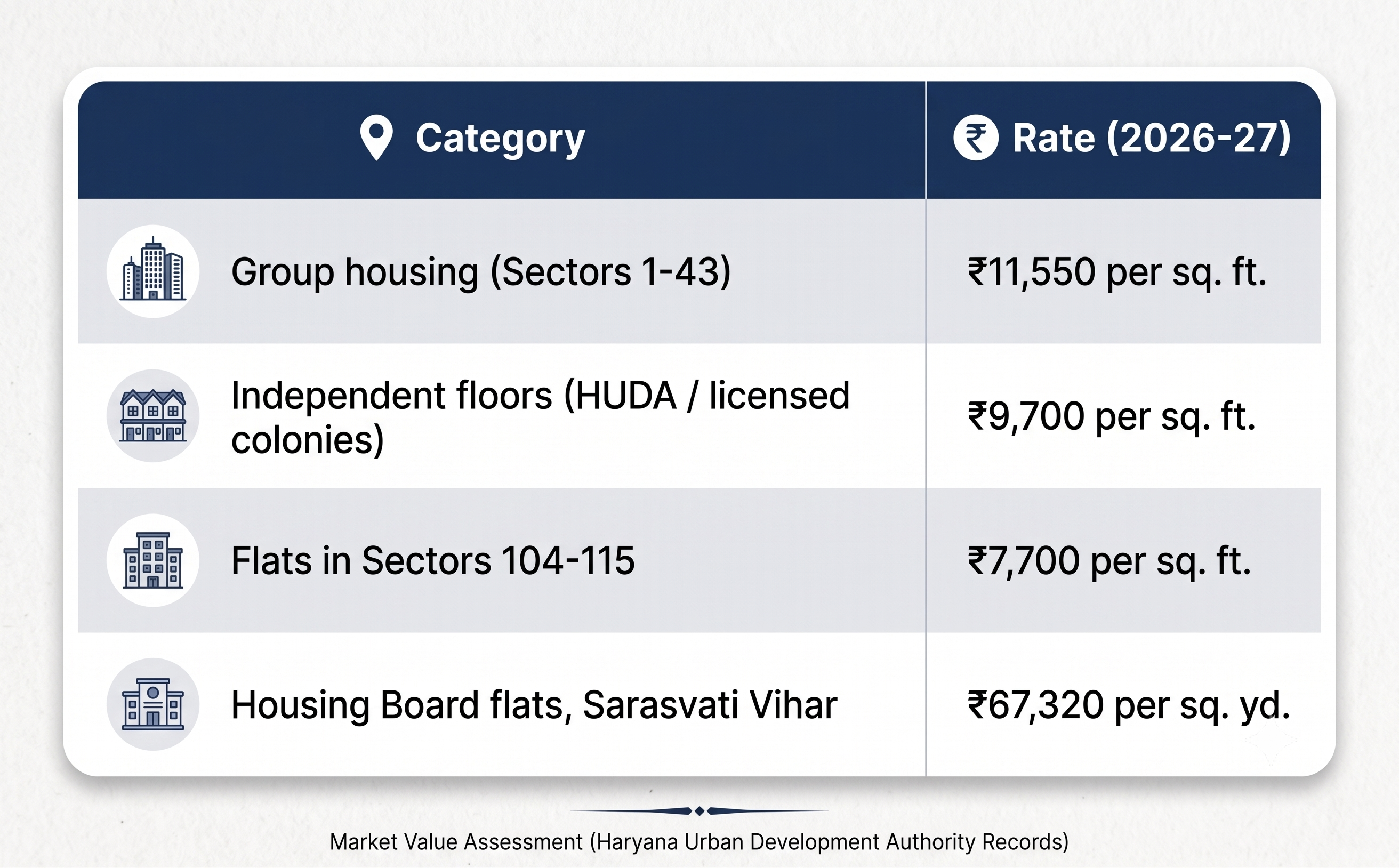
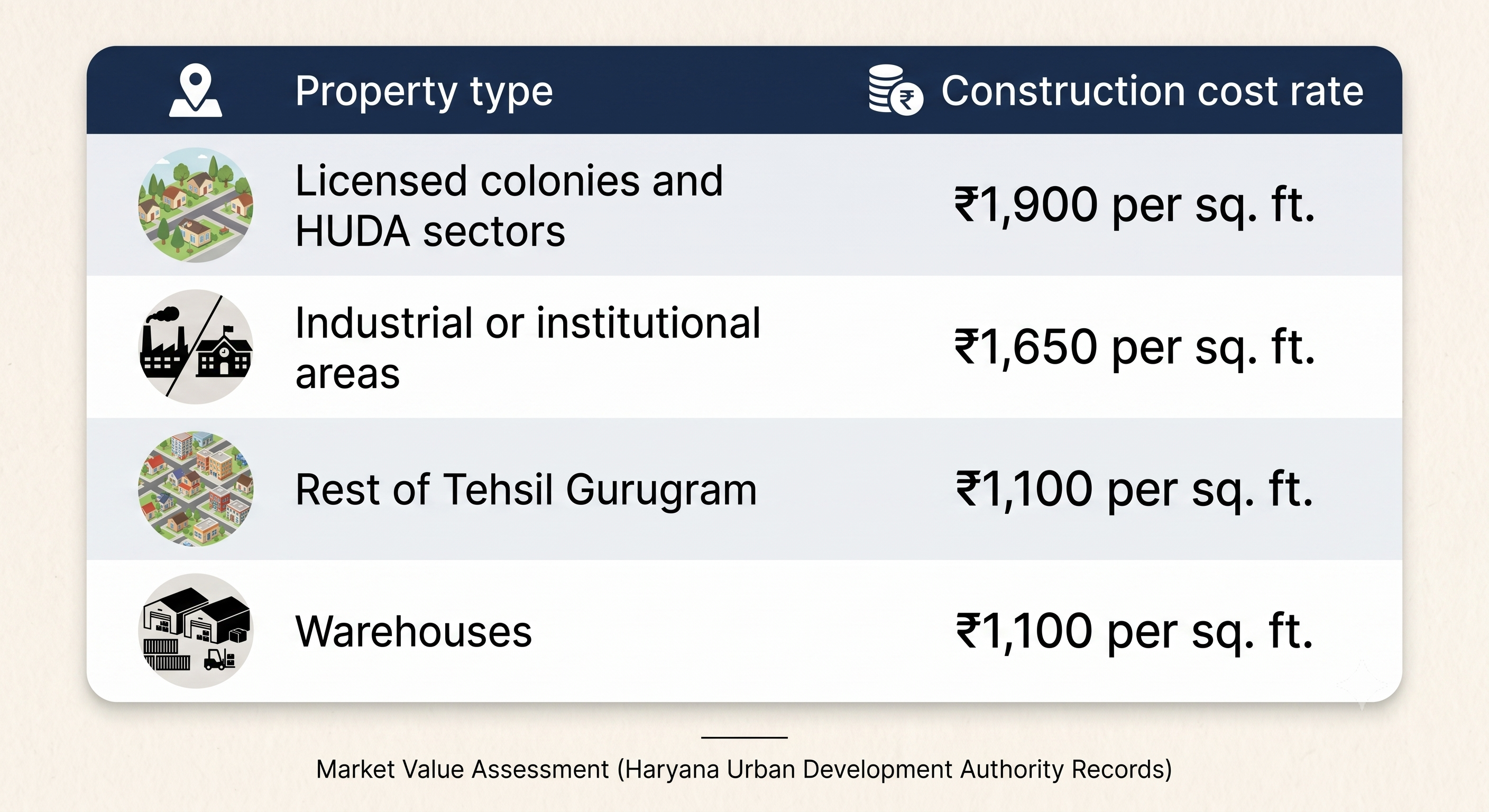
Construction cost is added on top of land value for registry purposes, and this varies by property category too:
How Stamp Duty and Registration Charges Work From Here
Once you know the applicable circle rate, the stamp duty math in Haryana follows a fixed structure based on where the property sits and who's buying it.
Urban Gurugram
- Male buyer: 7%
- Female buyer: 5%
- Joint ownership: 6%
Rural areas
- Male buyer: 5%
- Female buyer: 3%
- Joint ownership: 4%
On top of stamp duty, registration fees apply separately, typically 1% of the property value, though this is generally capped around ₹50,000 rather than scaling indefinitely on high-value transactions. It's worth confirming the current cap with your sub-registrar's office directly, since Gurugram circle rate figures and the fees built on top of them are periodically revised together.
A worked example: say a 1,500 sq. ft. independent floor in a licensed colony works out to ₹9,700 per sq. ft. under the current circle rate, that's ₹1.45 crore as the minimum assessable value. If your actual negotiated price is ₹1.35 crore, stamp duty is still calculated on the ₹1.45 crore circle rate figure, not your lower negotiated price, because the higher of the two always applies. For a male buyer in an urban area, that's roughly ₹10.15 lakh in stamp duty at 7%, plus registration fees on top.
Rules That Change Your Actual Circle Rate
A handful of valuation rules can push your assessable value well above the base sector rate, and these catch a lot of first-time buyers off guard.
- CLU (Change of Land Use) land can be valued at up to 3x the agricultural rate for residential use, 4x for group housing, and 5x for commercial use, a significant multiplier if your land was recently converted from agricultural status.
- National Highway or NPR frontage can add a 25% premium if the land sits within 2 acres' depth of NH-48 or the Northern Peripheral Road.
- Corner plots or park-facing plots can carry a 10% premium, and if a plot is both corner-facing and open on multiple sides, that premium can rise to 15%.
- Plot size matters for classification too, anything under 1,000 sq. yds. is treated as residential for stamp duty purposes regardless of how it's actually zoned.
None of these apply universally, they're conditional on your property's specific characteristics, but they're exactly the kind of detail that gets missed when someone only checks the headline sector rate and assumes that's their final number.
How to Check the Official Gurgaon Circle Rate for Your Property
- Visit gurugram.gov.in, the official district website.
- Look for the current year's Collector Rate notification, listed separately by tehsil (Gurugram, Badshahpur, Farrukhnagar, Wazirabad, Sohna, Manesar, and others).
- Download the PDF for your specific tehsil.
- Search within the document for your exact sector, colony, or village name; rates are listed by these specific entries, not by broad geographic zones.
- Cross-check the property category (residential plot, group housing, independent floor, commercial), since a single sector can carry multiple different rates depending on use.
If your sector or colony genuinely isn't listed by name, that usually means it falls under a broader village or road-facing category instead, in Haryana, unlike Delhi's simpler A-H category system, rates are notified individually by village, sector, and locality, which makes an exact-name search essential rather than optional.
What This Means If You're Buying, Selling, or Registering Property in Gurugram Right Now
If you're transacting in an older, established sector, Golf Course Road, DLF phases, MG Road, this revision probably changes very little for you, a meaningful share of these areas saw no increase at all. Your stamp duty math this year likely looks the same as last year's.
If you're anywhere in the Dwarka Expressway corridor, particularly Sectors 104-115, budget for real movement, even accounting for the conflicting figures across our sources, every single one agrees the direction is sharply up, not marginally. If you're mid-negotiation on a resale flat or plot here, it's worth getting the exact current rate for your specific sector confirmed before you finalize a price, since the stamp duty gap between the old and new rate could be substantial enough to affect your total transaction cost meaningfully.
If you're weighing whether to register now or wait, remember the Gurugram circle rate has historically been revised more than once within a financial year when market conditions shift quickly, so "this year's rate" isn't necessarily locked in for the full twelve months, particularly in fast-moving corridors.
Putting This Into Practice
If you're trying to work out how this year's circle rate revision affects a specific deal, particularly anywhere along Dwarka Expressway or the Southern Peripheral Road, it's worth knowing Gurgaon isn't the only NCR market working through this right now. Our Delhi circle rate guide breaks down that city's very different A to H system, useful context if you're weighing options on both sides of the border rather than assuming one city's rules carry over to the other.
We'll keep updating this guide to Gurgaon property circle rates as the district issues fresh notifications throughout the year, so it's worth bookmarking rather than treating it as a one-time snapshot.
Frequently Asked Questions
1. What is the circle rate in Gurgaon right now?
There's no single citywide figure, circle rate in Gurgaon varies by sector, colony, and property type. The 2026-27 revision, effective 1 April 2026, moved rates up by an average of 15% to 30% district-wide, with some areas frozen and others up as much as 75%.
2. Is the circle rate the same as the collector rate in Gurugram?
Yes. Gurugram's official documentation uses "collector rate," while "circle rate" is the more common everyday term. Both refer to the same government-notified minimum property valuation.
3. Can I register a property below the Gurgaon circle rate?
No. If your declared transaction value falls below the applicable circle rate for that location and property type, the registering authority can refuse the registration, or will simply calculate stamp duty on the higher circle rate figure regardless of your declared price.
4. How often does Gurgaon revise its circle rates?
Typically once a year, though Haryana has revised rates more than once within a single financial year in the past when market conditions moved quickly. The current 2026-27 rates took effect 1 April 2026.
5. Does circle rate affect capital gains tax, not just stamp duty?
Yes. Under Section 50C of the Income Tax Act, if your declared sale value is below the circle rate, the circle rate can be treated as the deemed sale value for capital gains calculation purposes, not just for stamp duty.
6. Where can I verify the official current rate for my exact sector?
Directly on gurugram.gov.in under the current year's Collector Rate notification for your tehsil. Third-party sites, including this one, are useful for context and comparison, but the official district PDF is the only document that should be treated as final for an actual registration.
FILED UNDER