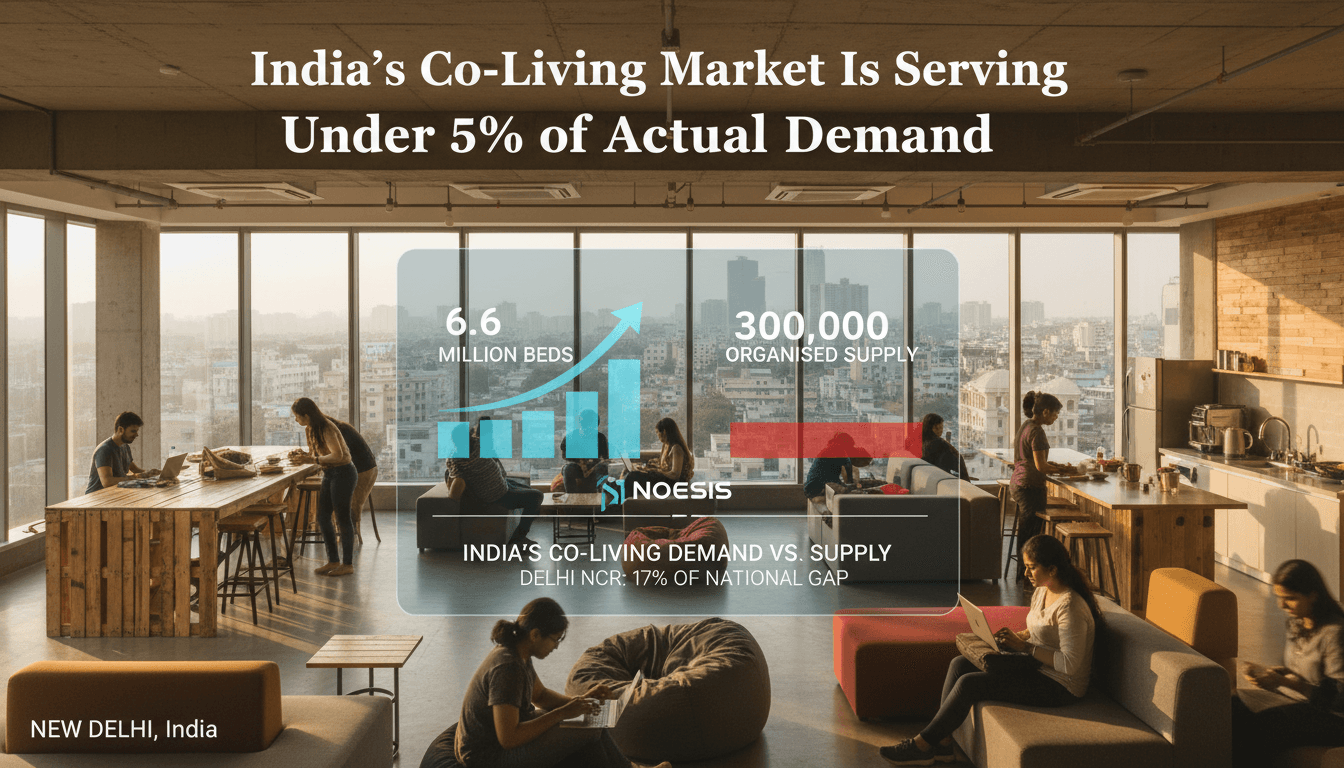
A 22-Times Gap Between Demand and Supply
If you've ever wondered why decent co-living options seem perpetually hard to find in most Indian cities, a new report from hospitality and branded-residences advisory firm NOESIS puts a number on that frustration. The study, titled "The Evolution of Co-Living: Market Dynamics and Investment Potential," estimates national co-living demand at approximately 6.6 million beds in 2025, against organised supply of only around 300,000 beds, a gap of nearly 22 times. By NOESIS's own framing, organised operators are currently serving under 5% of the addressable market.
Where NCR Fits Into the National Picture
Delhi NCR accounts for roughly 17% of national co-living demand, per the report, driven by two distinct engines: an annual higher-education intake exceeding 81,000 students, and what NOESIS describes as deep corporate relocation demand tied to the region's office and GCC employment base. That combination, students needing housing and relocating professionals needing flexible, managed accommodation, mirrors the national demand pattern the report identifies more broadly, where office and GCC leasing, education shortfalls, and industrial workforce housing together explain most of the gap.
The Numbers Behind the National Shortfall
The report ties demand growth to three structural drivers that don't depend much on consumer sentiment. India recorded 83.3 million sq ft of gross office leasing in 2025, with Global Capability Centres alone accounting for 31.4% of all leasing, a share NOESIS says rose further to roughly 45% in H1 2026. On education, India's higher education enrolment sits near 4.5 crore students, while campus accommodation covers only about a third of an estimated 12 million-bed student housing requirement. On the industrial side, the report points to over 4,500 mapped industrial parks nationally as a workforce housing pool that organised co-living supply has barely touched.
City-level gaps vary sharply. Hyderabad's shortfall runs about 4 times supply, Kolkata and Pune sit closer to 3-3.5 times, while Bengaluru and Ahmedabad/Gandhinagar are comparatively better served at roughly 2.5 times. Mumbai's demand, at an estimated 72,600 beds, is described in the report simply as "severely constrained" on the supply side, without a precise multiple given.
Why NOESIS Says This Isn't Really a Real Estate Play
The report's central argument is less about the size of the opportunity and more about what kind of business it actually is. Nandivardhan Jain, Founder and CEO of NOESIS, said India keeps calling co-living a real estate opportunity when it isn't one, arguing that co-living is an operating business that happens to occupy a building, and that real estate rewards patience while operating businesses punish inconsistency.
That framing shows up directly in the report's own numbers: professionally managed co-living assets can generate a revenue premium of 30-55% over traditional single-lease residential formats, but expense ratios run 60-75%, against just 35-45% for conventional residential assets. Vijay Bhandari, NOESIS's Chief Operating Officer, put it more bluntly, saying holding 92% occupancy while keeping expense ratios below 70% is where most operators actually lose the asset, and that consistency in operations is what separates a real business from rental arbitrage.
What the Growth Trajectory Looks Like
NOESIS projects the market growing from USD 0.53 billion in 2025 to USD 1.96 billion by 2031, a 24.34% CAGR, roughly INR 4,000 crore scaling to close to INR 20,000 crore. Even at that pace, organised inventory would only cross about one million beds by 2030, still marginally above 10% penetration against a demand pool the report expects to reach 9.1 million beds by then.
The report also flags a shift in what residents actually want within the category: private rooms now account for 45.7% of total market preference, a real move away from the format's shared-dorm origins, while the mid-scale price band dominates at 60.2% of inventory, suggesting the bigger opportunity sits below the premium end rather than at it.
Also Read: Top 10 Residential Projects in Noida Expressway in 2026: Ranked by Value, Location and Track Record
What This Means If You're Watching the Category
Worth being direct about the limits of this data: every figure and both quotes in this report come from NOESIS itself, there's no independent analyst or competing consultancy view included here to check these numbers against. That doesn't make the underlying data wrong, NOESIS is a genuine advisory firm with real specialization in this space, but it does mean this should be read as one firm's proprietary research and market positioning rather than an independently verified industry consensus.
If you're evaluating co-living as an investment category rather than just reading about it, that distinction, operating business versus passive real estate, is worth taking seriously regardless of which firm's numbers you're looking at, since it changes what kind of partner or operator track record actually matters before committing capital.
By the numbers · NEW DELHI, Delhi
38%
Capital-value growth, 2021–2025
50%+
Landscaped open area in new launches
24 mo
Window before supply catches demand