Two flats in different towers can both be advertised as 1,050 sq ft and still hand you different amounts of floor to live on. The gap usually comes down to one question: which "carpet area" is that number talking about?
Before 2016, the term had no uniform legal definition anywhere in India, so every builder drew the line wherever it suited the brochure. Section 2(k) of the Real Estate (Regulation and Development) Act, 2016 ended the guesswork by defining carpet area in one fixed way, and the Act applies across the country, barring Jammu and Kashmir. Even so, listings and sales calls still throw around carpet area, RERA carpet area, built-up area and super area as if they were the same thing.
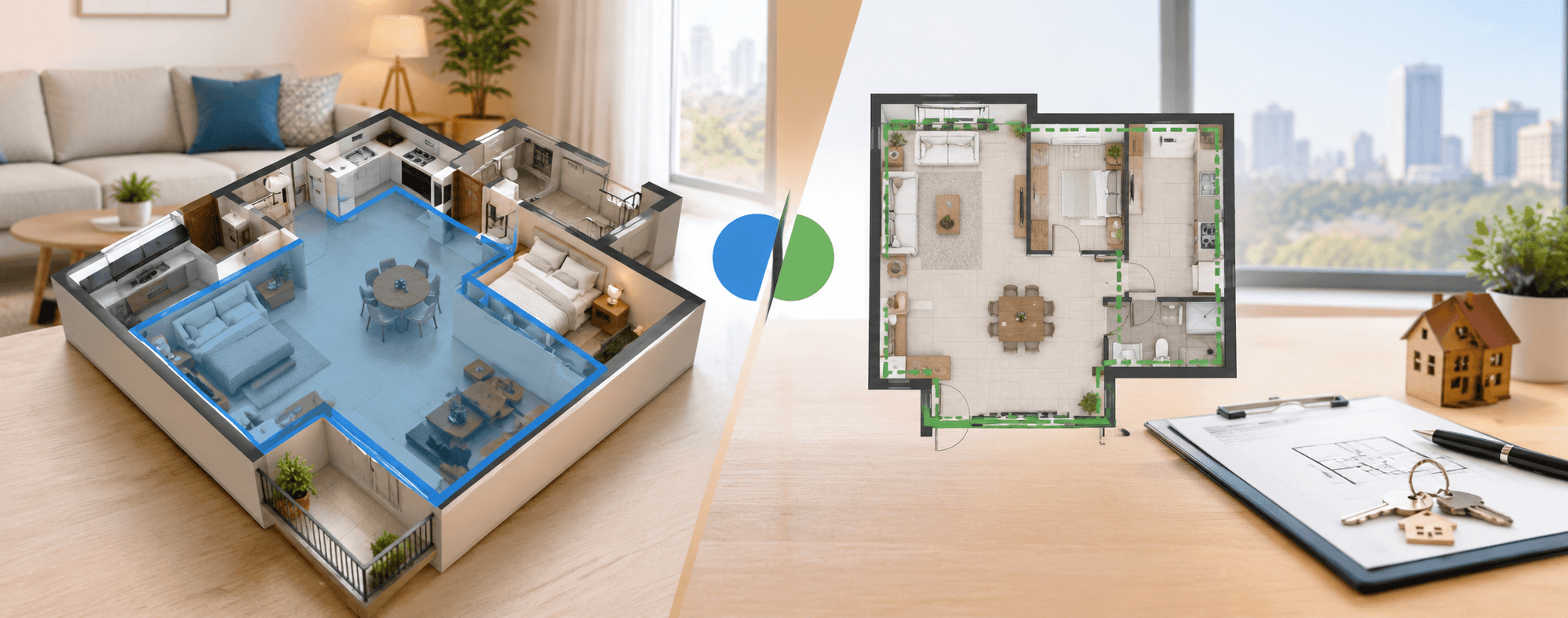
This guide sets out the distinction between the carpet area vs RERA carpet area in plain terms, draws it out so you can see the boundaries, runs the arithmetic on a worked example, and covers what most explainers skip: tolerance, balconies, the 70/30 rule, and what to check in your sale agreement before you sign, wherever in India you're buying.
The short answer: In everyday use, carpet area often refers to the usable floor space inside a flat, measured wall to wall. Under Section 2(k) of the RERA Act, carpet area is defined as the net usable floor area, including the area covered by internal partition walls, but excluding external walls, service shafts, exclusive balconies or verandahs, and exclusive open terraces. The term "actual carpet area" is sometimes used informally for usable floor space excluding wall footprints, so check exactly what a builder's quoted figure includes.
What Is a Carpet Area in Simple Terms?
Picture rolling a carpet across your bedrooms, living room, kitchen, toilets and the passage between them. The floor that carpet covers, measured from one wall face to the next, is often what people mean by usable or actual carpet area. However, this everyday usage is not the same as the statutory definition of carpet area under RERA, which also includes the area covered by internal partition walls.
The trouble is that the phrase had no uniform legal definition before RERA. Builders across different cities used it loosely. One might leave out shafts, another might fold in a balcony, a third might count a wall here and there. When you compared two projects, even in the same city, you were rarely comparing like with like.
What Is a RERA Carpet Area?
RERA carpet area is the net usable floor area of an apartment as defined in Section 2(k) of the Act. The clause is short, and you can read it in the RERA Act PDF on India Code. In simple words:
- Counted: the net usable floor area, plus the area covered by the internal partition walls of the apartment.
- Left out: external walls, areas under service shafts, the exclusive balcony or verandah, and the exclusive open terrace.
The Act adds that "exclusive" here means a balcony or terrace attached to your unit and meant only for your use. How a structural column standing inside your flat gets treated isn't spelled out word for word in the central Act, so it falls to each state's regulator to clarify.
Haryana's RERA authority did exactly that for projects in Gurugram district, through a 2021 regulation: any wall on the external face counts as an external wall, and any wall or independent column inside the apartment counts as an internal partition wall. That surprises many buyers.
A column standing in your living room is part of your RERA carpet area, even though you can't put a sofa there. Other states have issued their own clarifications or lean on the same reading, so it's worth checking how your state's authority treats columns before you take a builder's word for it.
Distinction between the Carpet Area and the RERA Carpet Area
Most of the distinction sits in two places, the internal walls and the legal status. Here is the side-by-side view.
| Point | Carpet area (usable) | RERA carpet area |
|---|---|---|
| Legal status | Everyday and marketing term, no single definition before 2016 | Defined in Section 2(k) of the RERA A |
| Internal partition walls | Left out, since it is measured wall to wall | Included |
| Columns inside the flat | Left out | Included, per most state regulators' reading |
| External walls | Excluded | Excluded |
| Service shafts | Excluded | Excluded |
| Exclusive balcony or verandah | Depends on who is quoting | Excluded, disclosed separately |
| Exclusive open terrace | Depends on who is quoting | Excluded, disclosed separately |
| Size for the same flat | Smaller | Larger by the internal wall footprint |
| Best used for | Planning furniture and layout | Price, agreement and legal comparison |
Where a builder's quoted usable area excludes internal wall footprints, the RERA carpet area will generally be larger. Some published guides estimate the difference at roughly 5% to 10%, but this is only an indicative range, not a statutory conversion rate. The actual difference depends on the layout, wall thickness and measurement method. Check the floor plan and the area definition used in your agreement before comparing figures.
How to calculate RERA Carpet Area (with a worked example)
You don't need a special tool. A RERA carpet area calculator is really three cells in a spreadsheet:
RERA carpet area = net usable floor area + footprint of internal partition walls (and any columns inside the flat)
- Measure each room from wall face to wall face and add them up. Include toilets, the kitchen and the passage. Leave out the balcony and the shafts.
- Work out the wall footprint by multiplying the total length of internal walls by their thickness.
- Add the area taken by any columns standing inside the flat.
Here is an illustrative example of the distinction between the carpet area and the RERA carpet area, using round numbers. Say your net usable floor area is 1,000 sq ft. The internal walls run for about 120 ft in total, and each is 4.5 inches (0.375 ft) thick. That gives 120 x 0.375 = 45 sq ft of wall. Your RERA carpet area is 1,000 + 45 = 1,045 sq ft, which is 4.5% more than the usable figure.
Going the other way: to find the carpet area from the RERA carpet area, subtract the internal wall footprint. In the example, 1,045 minus 45 gives back 1,000 sq ft. If all you have is the RERA number, dividing by 1.05 gives a ballpark (1,045 / 1.05 is about 995 sq ft), but treat that as a shortcut and check it against the plan.
One unit note: Agreements usually quote sq ft, while government notifications often use sq m. One sq m is about 10.764 sq ft.
Does RERA Carpet Area Include Balcony?
No, exclusive balcony, verandah and open terrace areas are carved out of the definition in the Act itself, which applies wherever RERA applies. Several states go further on disclosure. Haryana's Gurugram regulation, for instance, requires the promoter to state the carpet area alongside the area of the exclusive balcony or verandah and open terrace, each on its own line. So a plan might show 1,045 sq ft of RERA carpet area and, separately, a 60 sq ft balcony. If a listing quotes one combined number anywhere in the country, ask for the split before you compare it with anything else.
Carpet Area Tolerance As Per RERA: How Much Variation Is Allowed?
The RERA Act does not name a percentage. The 3% figure that gets quoted comes from the model agreement for sale that MahaRERA prescribes for Maharashtra. Its clause says the promoter confirms the final carpet area after the building is complete, subject to a variation cap of 3%. If the area falls short, the promoter refunds the excess money within 45 days, with interest at the rate set in the rules. If the area goes up, the promoter can ask you to pay for the extra at the next milestone.
Here is how that looks in numbers. Your agreement says 1,045 sq ft and the final measurement is 1,015 sq ft, a shortfall of 30 sq ft or about 2.9%. At an agreed rate of ₹9,000 per sq ft, the refund works out to ₹2.7 lakh, plus interest. A MahaRERA-based explainer makes the same point: a shortfall inside the 3% band is still refundable.
We have verified that exact clause for Maharashtra only. Most states have adopted a model agreement with a similar structure, a stated cap, a refund window, an interest rate, but the specific numbers can differ. Wherever you're buying, read the variation clause in your own draft agreement and match it against your state's rules before you sign.
MOFA Carpet Area vs RERA Carpet Area
MOFA is the Maharashtra Ownership of Flats Act, a state law that applies only within Maharashtra. You may still run into the term in older documents or in articles written about Mumbai and Pune. In one MahaRERA order, summarised by SCC Online, the authority noted that MOFA's disclosure rules counted the balcony in carpet area, while RERA excludes it.
So which is better? Neither wins on its own terms, because the question is about which law applies. The central RERA Act, 2016 extends across India except Jammu and Kashmir, which has its own Real Estate (Regulation and Development) Act, 2018. Under the applicable RERA framework, carpet area includes internal partition walls but excludes exclusive balconies and open terraces. If you see a MOFA figure on an older Maharashtra flat, check whether the balcony was included before comparing it with a RERA carpet-area figure.
Why The Number Matters Beyond Price
Carpet area shows up in places you might not expect:
- Your sale paperwork: Several states tie the registered conveyance deed to the carpet area figure. Haryana's Gurugram regulation, for one, says a conveyance deed is registered only on the carpet area basis, so the area in your agreement carries through to what the deed records. Ask your lawyer whether your state's registration practice does the same.
- GST on your flat: The GST Council's 2019 definition of affordable housing sets a carpet area limit of 60 sq m in metro cities and 90 sq m in non-metro cities, with a value cap of ₹45 lakh applying to both. The metro list for this purpose covers Bengaluru, Chennai, Delhi NCR (Delhi, Noida, Greater Noida, Ghaziabad, Gurugram and Faridabad), Hyderabad, Kolkata and the whole of the Mumbai Metropolitan Region. Both the area and value tests must be met together for the 1% rate instead of 5%, so confirm the current notification before you rely on it.
- Resale and rental comparison: If you are comparing your flat with others on carpet area, you are using the one number that is defined the same way across the country.
What Is the 70/30 Rule In RERA?
People mean two different things by it, and the confusion is common.
The Escrow Rule: Under Section 4(2)(l)(D), a promoter anywhere in the country must deposit 70% of the amounts realised from buyers in a separate bank account, to be used for construction and land cost. Withdrawals have to match the percentage of completion and be certified by an engineer, an architect and a chartered accountant. This rule protects the money you pay. It has nothing to do with the area.
The carpet-to-super ratio. In casual talk, "70/30" also describes a flat whose carpet area is about 70% of the super area, with 30% going to common space. That is a rule of thumb for loading, not a legal rule, and it varies by project regardless of city.
What to Check Before You Sign, Wherever You're Buying In India
- Look for three separate lines: Your agreement should show the carpet area, the balcony or verandah area and the open terrace area, each on its own line, not folded into one number.
- Match the number to the registration: Compare the carpet area in your draft with what the promoter disclosed on your state's RERA website for that unit type. Every state authority runs its own portal where this is public.
- Compare on carpet rate: Divide the price by RERA carpet area for every project on your shortlist, regardless of which city they're in. If you'd like a second opinion while you're comparing options, our listings are a reasonable place to cross-check prices against.
- Read the variation clause: Look for the percentage cap, the refund window and the interest rate in your specific agreement, since these differ by state.
- Ask for the plan with dimensions: You want wall thickness and room sizes, so you can run the formula above yourself.
- Measure at handover: Wall-to-wall dimensions with a laser measure, plus the wall footprint, should land close to the agreement figure.
Comparing headline sq ft across projects is the habit most worth breaking, because the numbers may have been measured in different ways, even within the same city. Ten minutes with the plan, before the booking amount moves, saves a lot of back and forth.
RERA Carpet Area PDF: Where to Find the Official Text
You don't have to rely on anyone's summary, including ours. The primary documents are free:
- The Act: The RERA Act PDF on India Code has Section 2(k), applicable nationwide.
- A State Regulation Example: The Gurugram carpet-area regulation PDF shows how one state explains walls, columns and balconies, and what penalties apply for selling on any other basis.
- Your Own State's Rules: Every state RERA authority publishes its own regulations and a model agreement for sale. Search for "[your state] RERA rules" or check your state authority's website directly, since the clauses that matter most to you, tolerance and disclosure, are set at the state level.
The Takeaway
If you take away one important lesson from this guide, let it be this: always ask for the RERA carpet area, balcony area and variation clause in writing. Compare projects based on the carpet area rate, regardless of which city you’re buying in.
If you’d like a second opinion on a draft agreement or floor plan before making a decision, you can connect with our advisors. We’ll help you review the details and understand the numbers before you commit.
Frequently Asked Questions
Carpet area in everyday use is the usable floor measured wall to wall. RERA carpet area is the legal figure from Section 2(k), which adds the footprint of internal partition walls and leaves out external walls, shafts, exclusive balconies and exclusive terraces. For the same flat, the RERA number is the larger one.
Subtract the area covered by internal walls and any columns inside the flat. If the RERA figure is 1,045 sq ft and the internal walls cover 45 sq ft, the usable carpet area is 1,000 sq ft. Without the plan, dividing by about 1.05 gives a rough estimate only.
The central RERA Act, 2016 extends across India except Jammu and Kashmir, which has its own Real Estate (Regulation and Development) Act, 2018. The central Act defines carpet area in Section 2(k), while applicable state rules and regulations may clarify matters such as internal columns, area disclosures and variation clauses.
They apply in different places. MOFA is a Maharashtra law and counts the balcony in carpet area, while RERA excludes it. Outside Maharashtra's pre-RERA bookings, RERA is the one that applies, and it is the uniform measure across the country.
The Act itself fixes no percentage. MahaRERA's model agreement sets a 3% variation cap, with a refund within 45 days for any reduction plus interest. Other states use their own model agreements, often with a similar structure but different numbers, so check the clause in yours.
No. Exclusive balcony, verandah and open terrace areas are excluded by the central Act and shown as separate figures. If a listing folds the balcony into one big number, it is not quoting the RERA figure, so ask for the split.
Formally, it is the escrow rule in Section 4(2)(l)(D): 70% of money collected from buyers goes into a separate project account, and this applies nationwide. Informally, people also use "70/30" for a carpet-to-super area ratio, which is a rule of thumb and not law.
RERA does not prescribe a share of carpet area in super areas. It fixes the definition. In practice, many projects have carpet area at roughly 65% to 75% of super area, and the 3% figure is a variation cap in Maharashtra's model agreement, not a share, and not a figure every state uses.
In Gurugram district, Haryana's 2021 regulation says an agreement on any basis other than carpet area is an unfair practice. Several other states have moved toward carpet-area-only pricing too, but the rules and their strictness vary, so check your own state authority's position before assuming the same protection applies.
Super built-up area is the carpet area plus wall thickness, balconies in most definitions, and your share of common areas. The carpet area is only the usable floor inside the flat, which is why it is always the smaller figure.
FILED UNDER