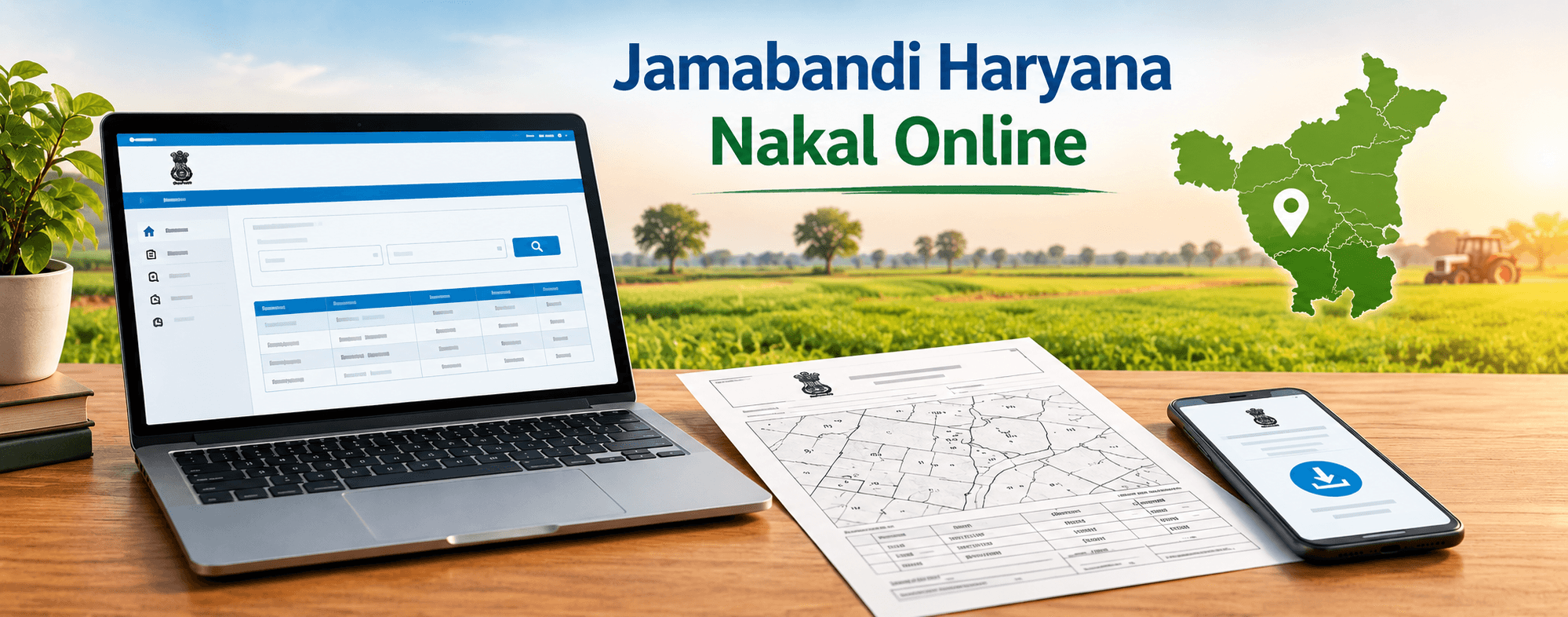
If you're buying land or a plot in Haryana, the first document worth pulling isn't the sale deed the seller hands you. It's the Jamabandi. This guide shows you how to check it yourself in about five minutes, for free, from your phone.
Quick answer: To check Jamabandi Haryana Nakal online, go to jamabandi.nic.in, open the Jamabandi menu, and choose "Jamabandi Nakal for checking." Select your district, tehsil and village, then search by owner name, khewat number or khasra number. Viewing is free. For a copy a bank or court will accept, get a digitally signed Fard from the same portal.
What Is Jamabandi Haryana?
Jamabandi is Haryana's Record of Rights for land. It's prepared for every revenue estate and contains entries on ownership, cultivation and the current state of various rights in the land. It's revised every five years, when the Patwari prepares a fresh Jamabandi and a Revenue Officer attests it.
In plain terms, the Jamabandi tells you who owns a piece of land, what share each owner holds, who cultivates it, and whether anything has changed through sale, inheritance or a court order.
The copy of that record is called a Jamabandi Nakal ("nakal" simply means copy). You'll also hear people call it the Fard.
One thing to know upfront: Jamabandi Nakal Haryana mainly covers rural and agricultural land. For urban properties, you'll usually need the property details issued by the local Municipal Corporation. So if you're buying a flat in a Gurugram society, the Jamabandi is only part of your paperwork.
Jamabandi Nakal vs Fard: Which One Do You Need?
People use these words interchangeably, but there's a practical difference in how the copy can be used.
The online Jamabandi Nakal you view on jamabandi.nic.in is for reference. It's perfect for a quick check before a site visit or a price conversation.
The digitally signed Fard (e-Fard) is the one that carries legal weight. Haryana started the digitally signed Jamabandi (e-Fard) system on 6 May 2023, so people no longer have to visit a Patwari's office for a signed Fard and can get one through the jamabandi.nic.in portal instead. This is the version to attach to a loan file or keep with your purchase documents.
A simple rule: check the free nakal first. Order the signed Fard once you're serious about a property.
How to Check Jamabandi Nakal Haryana Online (Step by Step)
Here's the exact process on the official Haryana land records portal:
- Open the portal: Go to jamabandi.nic.in (the WEB-HALRIS site run by the Haryana Revenue Department). Stick to this official address and avoid lookalike sites.
- Go to the Jamabandi menu: Click "Jamabandi," then "Jamabandi Nakal for checking."
- Choose how you want to search: You can search by Owner Name, Khewat, Khasra/Survey number, or Date of Mutation.
- Fill in the location: Select the District, Tehsil or Sub-Tehsil, Village and Jamabandi Year.
- Pick your record: If you searched by owner name, you'll see the khewat, khatoni, owner's name, father's name, grandfather's name and share. Select the right entry.
- View the nakal: Enter the captcha and click "Nakal." Your Haryana Jamabandi Nakal opens on screen, showing ownership, area and share details. Save or print it for your records.
A small tip: village names are sometimes spelled differently from how locals say them. If you can't find yours, scroll the dropdown slowly or try searching by khasra number instead.
How to Get a Digitally Signed Fard in Haryana
If you need an official copy for a bank, court, or registry, use the Fard service on the same portal. You log in, select the land details as above, pay a small fee online, and download a copy that carries the Patwari's digital signature.
On cost: when the service launched, the service charge was ₹100 per Fard, plus ₹10 for the first khewat and ₹5 for each additional khewat. Government fees change, so please confirm the current charge on jamabandi.nic.in before you pay.
Understanding the Terms on Your Jamabandi Nakal
The nakal can look confusing the first time. These are the words you'll see most often:
| Term | What it Means |
|---|---|
| Khewat | The ownership account number. Groups the land held by an owner or set of co-owners. |
| Khatoni | The cultivation account number. Shows who actually farms the land. |
| Khasra / Killa | The number of a specific plot or field within the village map. |
| Hissa | The share each owner holds. |
| Intkal (Mutation) | The record of a change in ownership, through sale, inheritance or gift. |
| Girdawari | The crop inspection record, updated each season by the Patwari. |
Why the Jamabandi Haryana Record Matters When You Buy Property
This is where most buyers get caught out. A clean-looking sale deed means very little if the land records don't match it.
Before you pay any token money, it's worth checking three records in this order:
- The Jamabandi: Does the seller's name actually appear as owner, with the share they claim to be selling?
- The mutation: Was the seller's own purchase properly mutated into their name? An unmutated earlier sale is one of the most common red flags in Haryana land deals.
- The registered deed: Does the previous sale deed exist in the registration records?
If you're buying in a licensed colony in Gurugram, Faridabad or Sohna, go a step further. For those areas, the Jamabandi alone isn't enough: you should also confirm the DTCP licence, the HSVP allotment, and the Haryana RERA registration.
And if the Jamabandi shows many co-owners, don't panic. It's common on ancestral land. It just means you need to know exactly whose share you're buying and whether it's been partitioned.
Common Problems with Haryana Jamabandi Nakal Online (and What to Do)
Record not found: Check the Jamabandi year. Records are revised every five years, so an older entry may sit under a previous year.
Name spelled differently: Names are often recorded in Hindi or with older spellings. Search by khewat or khasra number instead.
Portal slow or not loading: It tends to be busiest during office hours. Try early morning or late evening.
Details look wrong: Don't try to fix it through anyone offering a "shortcut." Contact the Patwari or tehsil office and apply for a correction through the proper channel.
A Few Minutes That Can Save You a Lot
A quick check on jamabandi.nic.in is one of the simplest ways to protect yourself before any land or property deal in Haryana. And if the nakal raises more questions than it answers, that's normal. When in doubt, a property lawyer or your local tehsil office can help you read it correctly.
At Hommea, we work with luxury homes, and we believe that a well-informed buyer makes a better decision at every price point. That's why we share guides like this one. If you're exploring premium residences, have a look at what we're offering.
FAQs on Jamabandi Haryana Nakal
What is Jamabandi Nakal Haryana?
Jamabandi Nakal Haryana is a copy of the Jamabandi, the official Record of Rights for land in Haryana. It shows the owner, cultivator, share, area and any recorded changes like mutations.
How can I check Jamabandi Haryana online?
Visit jamabandi.nic.in, choose "Jamabandi Nakal for checking," select your district, tehsil and village, and search by owner name, khewat or khasra number.
Is checking Haryana Jamabandi Nakal online free?
Yes, viewing the Jamabandi Nakal on the portal is free. A digitally signed Fard carries a small fee, which you should confirm on the portal before paying.
Is a digitally signed Fard legally valid in Haryana?
Yes. A digitally signed Fard downloaded from jamabandi.nic.in is an official copy. Still, check with your bank or sub-registrar which version they'll accept for your specific case.
Can I download Jamabandi Nakal by owner name?
Yes. Choose "Owner Name" as the search option, pick the correct entry from the list, and the Jamabandi Nakal will open with the khewat and share details.
What's the difference between khewat and khatoni in the Jamabandi?
Khewat is the ownership account number. Khatoni is the cultivation account number, showing who farms the land. One khewat can include several khatonis.
Does Jamabandi Haryana cover flats and urban property?
Mostly no. Jamabandi Haryana mainly covers rural and agricultural land. For flats and urban plots, you'll also need municipal records and, for projects, the RERA registration.
How often is the Jamabandi updated in Haryana?
The full Jamabandi is revised every five years by the Patwari and attested by a Revenue Officer. Mutations are recorded as they're sanctioned in between.
This guide is for general information. Government fees and portal steps can change, so please confirm the latest details on jamabandi.nic.in or with your local tehsil office.
FILED UNDER