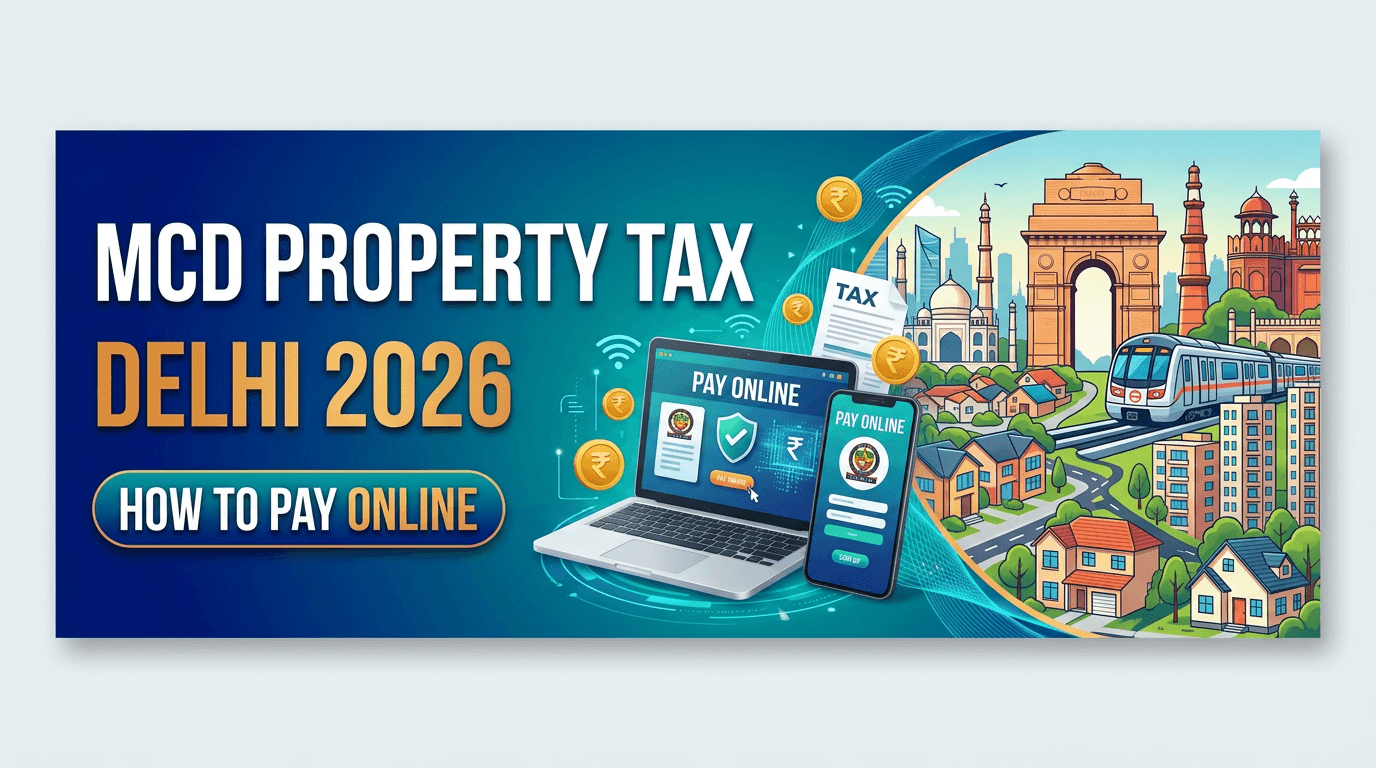
If you own a home, a shop or even an empty plot in Delhi, you owe MCD property tax every year. The good news is that the whole process now happens online, receipt included, and you can usually finish it in one sitting once you know where to click.
At Hommea, we get asked about this a lot, usually by people who have just bought a flat and are staring at a bill they don’t understand. So we’ve put together the guide we wish we could hand them. We checked the rules against MCD’s own user manual, its official circulars and a 2025 Delhi High Court judgment, and we’ve flagged the places where popular websites get it wrong.
Quick answer: what is MCD property tax?
MCD property tax is an annual tax on buildings and vacant land inside Municipal Corporation of Delhi limits. You pay it online at mcdonline.nic.in using your 15-character UPIC (Unique Property Identification Code). The tax is a percentage of your property’s annual value, which MCD works out with the unit area method. Residential rates are 12%, 11% or 7% depending on your colony’s category. For 2026-27, MCD offered a 10% rebate for paying the full year by 31 July 2026. Unpaid tax attracts interest at 1% a month.
MCD property tax 2026-27 at a glance
| Item | What applies |
|---|---|
| Who collects it | Municipal Corporation of Delhi, Assessment & Collection Department |
| Where to pay | mcdonline.nic.in or MCD’s mobile app |
| Property ID you need | UPIC, 15 characters |
| Calculation method | Unit area method |
| Residential tax rate | 12% (A, B), 11% (C, D, E), 7% (F, G, H) |
| Early payment rebate 2026-27 | 10% on lump-sum payment, deadline extended from 30 June to 31 July 2026 |
| Late payment | Interest at 1% per month on unpaid tax |
| Special rebates | 30% for senior citizens, women owners, ex-servicemen and persons with disabilities, up to 100 sq m |
Who collects property tax in Delhi?
MCD collects property tax for most of Delhi, but not all of it. Before you log in anywhere, check which civic body your property falls under, because paying the wrong one doesn’t clear your dues.
| Civic body | Areas covered | Where you pay |
|---|---|---|
| Municipal Corporation of Delhi (MCD) | Most of Delhi, including Delhi’s urban villages and authorised and unauthorised colonies | mcdonline.nic.in |
| New Delhi Municipal Council (NDMC) | Lutyens’ Delhi, Connaught Place, Chanakyapuri and nearby areas | NDMC’s own portal |
| Delhi Cantonment Board | Cantonment areas | Cantonment Board |
Until 2022, Delhi had three separate corporations: North, South and East. They were merged back into a single MCD in May 2022, and MCD introduced uniform property tax rates across the city from July 2022. So if an older receipt shows South DMC, North DMC or East DMC, don’t worry. Your property now sits with the unified MCD, and you pay through the same portal.
One quick tip from us: your sale deed or old tax receipt usually names the ward and zone. Keep it handy, because you’ll need the colony name to find your property on the portal.
How is MCD property tax calculated?
MCD calculates your property tax with the unit area method. It first works out your property’s annual value, then charges a percentage of that value as tax. The formula, as the Delhi High Court set it out in a September 2025 judgment, is:
Annual Value = Unit Area Value × Covered Area × Age Factor × Use Factor × Structure Factor × Occupancy Factor
Property Tax = Annual Value × Tax Rate
It looks heavy, but each piece is simple once you see what it stands for.
1. Unit area value: your colony category matters most
MCD groups every colony into one of eight categories, A to H. Category A covers the most expensive neighbourhoods and H the least. Each category has a fixed unit area value per square metre of covered area. When you pick your colony on the portal, its category comes with it.
| Colony category | Unit area value (₹ per sq m per year) | Residential tax rate |
|---|---|---|
| A | 630 | 12% |
| B | 500 | 12% |
| C | 400 | 11% |
| D | 320 | 11% |
| E | 270 | 11% |
| F | 230 | 7% |
| G | 200 | 7% |
| H | 100 | 7% |
The Delhi High Court judgment confirms the range of ₹630 for Category A down to ₹100 for Category H. The values in between are the standard figures used across MCD guides; the portal’s own calculator applies the exact value for your colony.
2. Covered area
This is the built-up floor area of your unit in square metres, floor by floor. It is not the plot area and not the super area a builder quotes. If your sale deed shows square feet, divide by 10.764 to get square metres.
3. Age factor
Older buildings pay less. The age factor runs from 0.5 for construction before 1960 up to 1.0 for anything built in 2000 or later.
| Year of construction | Age factor |
|---|---|
| 2000 or later | 1.0 |
| 1990 to 1999 | 0.9 |
| 1980 to 1989 | 0.8 |
| 1970 to 1979 | 0.7 |
| 1960 to 1969 | 0.6 |
| Before 1960 | 0.5 |
4. Use factor
The use factor reflects what happens inside the building. Homes pay the base rate, and commercial use costs more.
| Use of the property | Use factor |
|---|---|
| Residential and public purpose | 1 |
| Public utilities | 2 |
| Industry, entertainment, recreation and clubs | 3 |
| Business | 4 |
| Star hotels (3-star and above), hoardings and towers | 10 |
5. Structure factor
Pucca and semi-pucca buildings carry a factor of 1. Kutcha structures carry 0.5.
6. Occupancy factor
If you live in the property yourself, the factor is 1. If you’ve rented it out, it doubles to 2. This is the one that surprises landlords most, because renting out a flat doubles its annual value.
Tax rates for non-residential property
Non-residential property up to 1,500 sq ft pays 20% in Categories A to E and 15% in the lower categories. Anything above 1,500 sq ft pays a uniform 20%. Industrial property pays 15%. MCD also adds a 1% education cess, which shows up in the final bill on the portal.
A worked example
Say you own a 100 sq m flat in a Category D colony. It was built in 2008, you live in it yourself, and it’s a regular pucca building.
- Annual value = 320 × 100 × 1.0 × 1 × 1 × 1 = ₹32,000
- Property tax at 11% = ₹3,520 a year
- If you rented the same flat out, the occupancy factor becomes 2, the annual value becomes ₹64,000 and the tax becomes ₹7,040
- If you’re a senior citizen living in it yourself, a 30% rebate brings the tax down to ₹2,464
Treat this as a rough estimate. Your actual bill on the portal will add the education cess and apply any rebate or interest that’s due, so always check the final figure there before you pay.
How to pay MCD property tax online
You pay MCD property tax online at mcdonline.nic.in. The steps below follow MCD’s own user manual for taxpayers.
- Open the portal. Go to mcdonline.nic.in, choose Online Services, and click Pay Property Tax.
- Register or sign in. First-time users sign up with their name, father’s or husband’s name, mobile number and email, then confirm the mobile number with an OTP. Returning users sign in with mobile and OTP, or with a login ID and password. You’ll land on the Taxpayer Dashboard.
- Find your property. Search by UPIC, by an old receipt number and the year it was paid, or by colony and owner name. When your property shows up, select “Use this property to pay tax”.
- Check the property details. Under Action, open “Edit Property/Owner details”. Confirm the property type, covered area and the tax factors for each floor, and select any rebate you’re eligible for. Joint owners enter their ownership share here.
- Pick the financial year and review the bill. Choose 2026-27 (and any earlier unpaid year) and open the Tax Payable tab. This is where you see the final amount, including cess, rebate or interest.
- Pay. Click Pay Tax, choose a payment gateway, and pay by net banking, debit or credit card, UPI or wallet. You can also pay by cheque using a challan generated on the portal and deposited at an Axis Bank branch.
- Save your receipt. Download it straight from the dashboard once the payment goes through.
If money left your account but the portal says the payment failed, don’t pay again straight away. Go to Action and use “Verify Payment Status” for that UPIC first. A successful status makes the receipt available.
What is a UPIC and how do you find it?
Your UPIC (Unique Property Identification Code) is a 15-character ID that MCD gives each property. It’s printed on your earlier property tax receipts. If you can’t find it, search for your property on the portal by colony and owner name.
If your property has never been registered, choose “Apply for New UPIC” on the dashboard. You’ll enter the ownership, location and owner details, and upload your PAN card, ID proof and a property document such as the sale deed. The new UPIC appears in draft until it’s processed.
How to download your MCD property tax receipt
- Sign in and go to the Taxpayer Dashboard.
- Click Action next to your UPIC and choose Payment Passbook.
- Select the financial year to see every payment made for that property.
- Click Download Receipt.
We’d suggest saving a PDF of every year’s receipt. Banks ask for them when you take a home loan against the property, and buyers ask for them when you sell.
Can you pay MCD property tax offline?
Yes. You can pay by cheque with a challan generated on the portal and deposited at an Axis Bank branch, and your zone’s Assessment & Collection Department office can help if you’re stuck. Online payment is still the faster route, and it gives you an instant receipt.
MCD property tax last date, rebate and interest for 2026-27
For 2026-27, MCD gave a 10% rebate to anyone who paid the full year’s tax in one go by 31 July 2026. The original deadline was 30 June 2026, and MCD’s Assessment & Collection Department extended it by a month through an office order. That window has now closed.
| What | 2026-27 position |
|---|---|
| Lump-sum rebate | 10% of the year’s tax |
| Original rebate deadline | 30 June 2026 |
| Extended rebate deadline | 31 July 2026 |
| Interest on unpaid tax | 1% per month, charged as simple interest |
What happens if you pay late?
If you haven’t paid your 2026-27 property tax yet, you’ve missed the rebate, and interest at 1% a month now runs on the unpaid amount. MCD charges it for each month, or part of a month, until you clear the dues. The portal adds it to your bill automatically, so the amount you see on the Tax Payable tab is what you owe today.
Leaving it longer only makes it worse. MCD can attach bank accounts or property and start prosecution under the Delhi Municipal Corporation Act, 1957, to recover old dues. If you’re behind, our honest advice is to pay this year’s tax now and sort out any arrears with your zonal office.
Is the SUNIYO amnesty scheme still open?
No. SUNIYO (Sumpattikar Niptaan Yojana) was MCD’s one-time amnesty for old property tax dues. It waived interest and penalties, and all dues from before 2020-21, for owners who paid the principal tax for 2025-26 and for 2020-21 to 2024-25. It first ran from June to September 2025, was extended into 2026, and closed on 30 April 2026. Delhi’s mayor said at the time that there would be no further extension.
If you missed SUNIYO, your old dues now carry the usual interest and penalties.
Plan ahead for 2027-28
MCD announces each year’s rebate window separately, so the 2027-28 deadline isn’t fixed yet. Keep an eye on the portal from April 2027, and pay early if you can. Ten percent off for paying on time is an easy saving.
MCD property tax rebates and exemptions
Some owners pay less, and a few pay nothing at all. MCD’s user manual lists a 30% rebate for four groups of owners, applicable only up to 100 sq m of area.
| Who qualifies | Rebate |
|---|---|
| Senior citizens | 30% |
| Women owners | 30% |
| Ex-servicemen | 30% |
| Persons with disabilities | 30% |
A quick word of caution here. Many websites say these rebates cover up to 200 sq m. MCD’s own manual says 100 sq m, and that’s the figure we’d go by. If your home is bigger, ask your zonal office how the rebate will be applied before you file.
Who is fully exempt?
The Delhi Municipal Corporation Act exempts a few kinds of property from property tax. These include:
- Property owned and lived in by war widows and gallantry award winners from the defence, police and paramilitary forces, and civilians holding top bravery awards. It covers one self-occupied home in Delhi, with no part rented out.
- Places of public worship, and public burial and cremation grounds.
- Heritage land and buildings.
- Property used for public charity or free medical or educational services.
- Land and buildings used for agriculture.
- Residential property in village abadi areas, up to 100 sq m of covered space.
You claim an exemption while filing your return on the portal, and you may need supporting documents.
Buying or selling? Check property tax first
When you buy a resale home in Delhi, unpaid property tax is a charge on the property itself, so the seller’s old dues can follow it to you. Before you sign, we’d ask the seller for:
- The UPIC of the property
- Property tax receipts for at least the last few years
- Confirmation on the portal that nothing is pending for the current year
After registration, update the owner’s name with MCD so that future bills come to you. On the portal, the new owner raises a request to have the existing UPIC transferred, and an MCD officer approves or rejects it. Keep your registered sale deed, PAN card and ID proof ready.
If you’re still weighing up a Delhi home, our Delhi circle rate guide helps you work out stamp duty, and our guide to Delhi’s posh areas explains why the colony you choose also affects your yearly tax.
A final word from Hommea
Property tax is one of those bills that’s easy to put off and annoying to deal with later. Find your UPIC, check that your covered area and occupancy are right on the portal, and pay before the rebate deadline each year. That small habit saves you money and keeps your paperwork clean for the day you sell or take a loan.
Rules and rates can change, so always confirm the final amount on mcdonline.nic.in before you pay. And if you’re buying a home in Delhi and want someone to look over the tax history with you, talk to us. At Hommea, we’re happy to help.
FAQs on MCD property tax
1. What is MCD property tax?
MCD property tax is an annual tax that the Municipal Corporation of Delhi charges on buildings and vacant land within its limits. It covers residential, commercial, industrial and institutional property, and the owner is responsible for paying it.
2. How do I pay MCD property tax online?
Go to mcdonline.nic.in, open Pay Property Tax, and sign in with your mobile number and OTP. Search for your property by UPIC, old receipt number or colony and owner name, check the details, pick the financial year and pay by net banking, card, UPI or wallet.
3. What is the last date to pay MCD property tax for 2026-27?
The 10% rebate deadline for 2026-27 was extended from 30 June 2026 to 31 July 2026. You can still pay after that, but interest at 1% per month applies on the unpaid amount.
4. How is MCD property tax calculated?
MCD uses the unit area method. Annual value equals unit area value × covered area × age factor × use factor × structure factor × occupancy factor. The tax is a percentage of that annual value: 12%, 11% or 7% for homes, depending on the colony category.
5. What is a UPIC number in MCD property tax?
UPIC stands for Unique Property Identification Code. It’s a 15-character ID for your property, printed on your earlier MCD property tax receipts. If your property doesn’t have one, you can apply for a new UPIC on the portal.
6. How can I download my MCD property tax receipt?
Sign in to the portal, click Action next to your UPIC, open Payment Passbook, select the financial year and click Download Receipt.
7. Who gets a rebate on MCD property tax?
Senior citizens, women owners, ex-servicemen and persons with disabilities get a 30% rebate, applicable up to 100 sq m of area as per MCD’s user manual. Everyone who paid the full 2026-27 tax by 31 July 2026 also got a 10% rebate.
8. What is the penalty for late payment of MCD property tax?
MCD charges simple interest at 1% per month, or part of a month, on unpaid property tax. For long-pending dues, MCD can also attach bank accounts or property and start prosecution.
9. Is MCD property tax higher for a rented flat?
Yes, The occupancy factor is 1 for a self-occupied property and 2 for a rented one, so renting out a flat doubles its annual value and its property tax.
10. Do I pay MCD property tax if I live in Lutyens’ Delhi or a cantonment?
No, Properties under the New Delhi Municipal Council pay NDMC, and properties in cantonment areas pay the Delhi Cantonment Board. MCD collects for the rest of Delhi.
FILED UNDER