HOMMEA
← The Hommea Journal
Real Estate

South Korea's Lee Jae-myung Hits New Approval Low as Seoul Housing Crisis Deepens

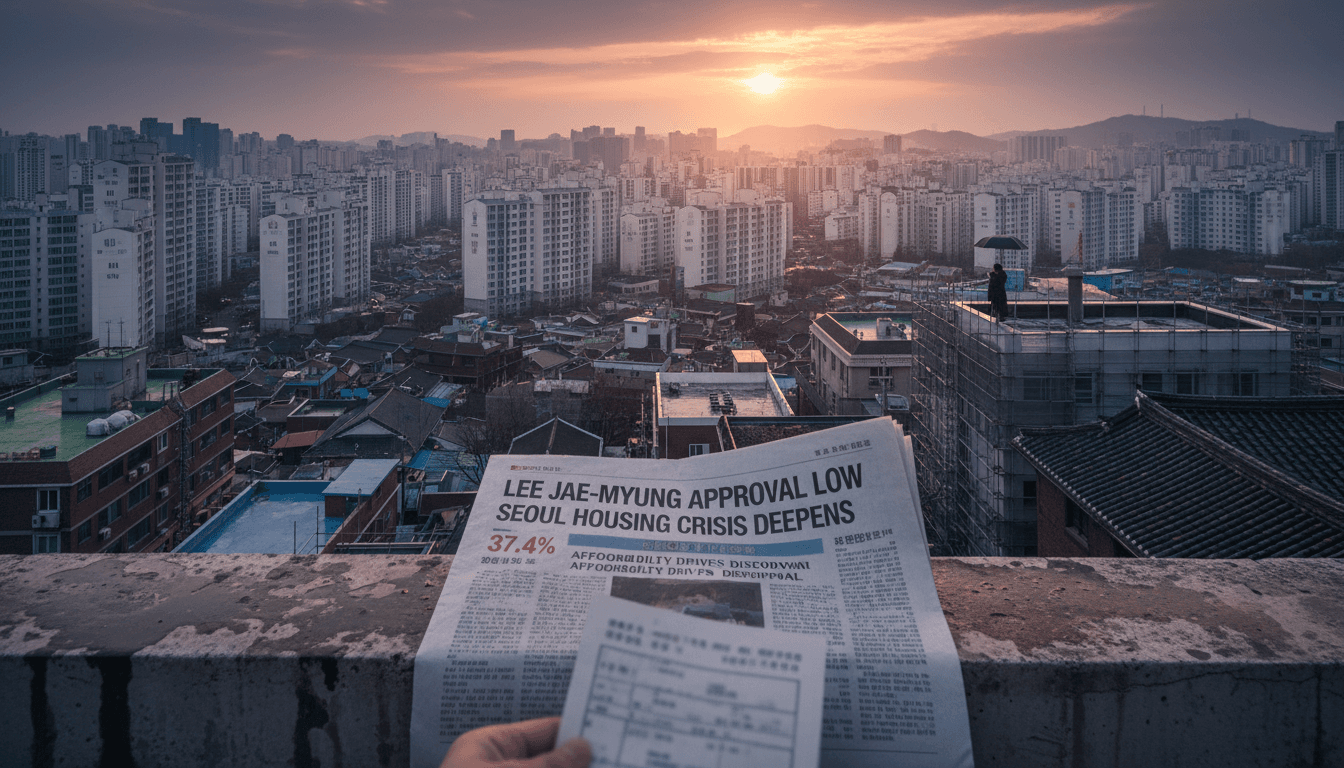
President Lee Jae-myung's approval rating fell to 37.4% this week, with housing affordability the single biggest driver of public disapproval in South Korea.

By Ananya Rao/September 15, 2026/2 min read/SEOUL, South Korea
South Korea's Lee Jae-myung Hits New Approval Low as Seoul Housing Crisis Deepens

The Numbers Behind the Political Fallout

South Korean President Lee Jae-myung's approval rating fell to a new low this week, entering the second year of his five-year term under mounting public pressure. A Realmeter survey published Monday put disapproval at 63.3%, against 33.8% who rated his performance positively. Separately, a Gallup Korea poll released just days earlier had already shown his approval sliding to 37.4%, the lowest since he took office. Housing sits at the center of both surveys as the leading reason for public dissatisfaction.

Housing Has Topped the Blame List for Weeks

This isn't a sudden dip. Gallup Korea's tracking shows a clear trend line: Lee's approval stood at 42% in late August, slid to 38% by mid-September, and has now fallen further. Housing policy has ranked as the single largest reason cited for disapproval for at least four consecutive weeks, ahead of cabinet appointments and other policy missteps. Support has reportedly drained fastest among young people, moderates, and residents of the greater Seoul area specifically, the demographic most directly exposed to the city's housing costs.

Read Now: India's Housing Prices Rose 6-7% in Q1 FY27, With Delhi-NCR and Bengaluru Leading the Gains

What's Actually Driving Seoul's Prices Up

The price pressure behind this political story has a fairly specific source: South Korea's AI-driven chip boom. Wealth effects from semiconductor giants Samsung Electronics and SK Hynix have spilled directly into the property market, particularly in neighbourhoods near their manufacturing and headquarters operations. Seoul home prices have climbed roughly 30% over two years on the back of this dynamic, and the city center now commands around $25,545 per square meter, making Seoul the world's third most expensive housing market by that measure. Lee himself has called the situation a "time bomb," a fairly blunt admission for a sitting head of state to make about his own country's housing market.

The Government's Response So Far

Lee's administration has moved on two fronts at once, expanding housing financing support to 47.8 trillion won and adding plans for 230,000 new homes. At the same time, it has kept lending restrictions in place to cool speculative demand, a combination that's proven difficult to balance. Easing credit too much risks reinflating the very price surge driving public anger, while keeping restrictions tight continues to lock young, first-time buyers out of the market, the exact voters whose support has fallen fastest.

Worth Reading: India's Real Estate Could Double Its GDP Share by 2047, Knight Frank's Zia Says, But Affordability Is the Catch

A Pattern That Extends Beyond Korea

Housing affordability becoming a genuine electoral liability isn't unique to Seoul. India's own policymakers have leaned on a similar toolkit, expanded financing support through schemes like PMAY, targeted new-home construction, and periodic tightening or easing of lending norms, precisely because the underlying tension is the same everywhere prices run ahead of wages: broadening access to financing without letting that same financing further inflate the prices it's meant to make affordable.

By the numbers · SEOUL, South Korea
38%
Capital-value growth, 2021–2025
50%+
Landscaped open area in new launches
24 mo
Window before supply catches demand
AR
Ananya Rao
Markets editor at Hommea, covering residential pricing, infrastructure, and sustainable development across Delhi NCR.
Keep reading